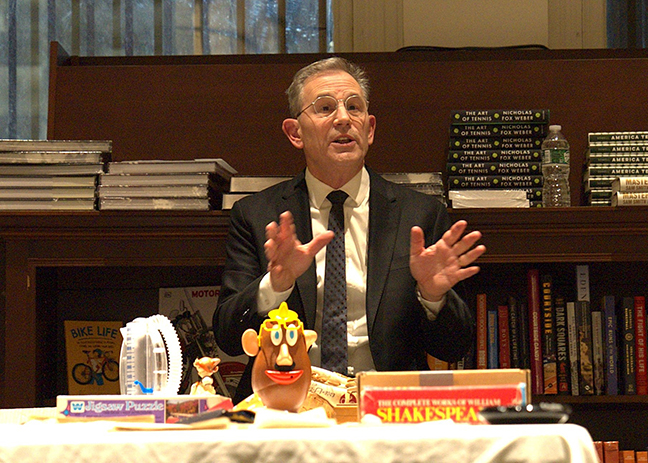
On the second floor of McNally Jackson at the South Street Seaport, in the children’s section of the bookstore, a long table displays objects including a baseball glove, a Mr. Potato Head, and a collection of silk neckties. Two rows of chairs surround the table on three sides. This is stage and theater. A show is about to begin.
Because I write about books, the premise of a play in a bookstore immediately intrigued me. I invited the paper’s theater critic, Mark Dundas Wood, to join me because I wanted his take as a theater professional.
Audience members drift in and peel off their winter layers. The bolder ones go right up to the table and pick up objects to examine them more closely. A book launch in the next room carries the sound of clapping and conversation. Some people come in carrying plastic cups of wine, stumbling over coats and bags in the tight rows.
After everyone takes their seats, playwright and performer Ed Schmidt squeezes past to the head of the table. “It’s a little tight tonight, but we’ll make it work,” he says. “Now it’s time for the play to begin.”
Schmidt’s one-man show, “Edward,” revolves around the objects on the table. He doesn’t portray Edward; he narrates his life. He asks audience members to select an object. Each one is a clue to who he is. The evening had the air of a séance. It felt like we were conjuring a real person from the dead.
A picture starts to form in our minds. Edward is a husband and a father. He’s an English teacher at a small private school. He continues to wear ties long after they’ve gone out of fashion. He argues with colleagues and his department chair about the importance of Shakespeare in freshman students’ lives. At the end of his marriage, he swipes a Hummel figurine from his wife’s collection—part petty act, part keepsake. Edward is a man who clings to the way he’s always done things, even when they no longer serve him well.
A few stories follow a list format. One lands almost as a one-line aside. Others stretch into longer memories. The shifts in form keep the evening from feeling repetitive. After each story, Schmidt puts the related object in a worn cardboard box—a time capsule of Edward’s life.
The order of the stories changes at every performance, depending on which items audience members pick. Because the play moves from bookstore to bookstore, the room changes as well—seating, lighting, proximity—reshaping the experience each time.
The play’s shifting structure made me think of the documentary “Eno,” which created buzz for its use of generative software to produce a different cut at each screening. Having a computer pick scenes at random felt like a gimmick.
So how well does this structural experiment work in “Edward”? After the show, Mark emailed me his thoughts: “What makes the play so tantalizing is that, because individual audience members select which artifact comes next, they are, together, creating a version of Edward’s story that is virtually unique.”
The play’s emphasis on the importance of objects reminded me of an article in The New York Times I recently contributed to about the things people keep as reminders of love. For me, it was a table runner made by my grandmother’s best friend—a symbol of chosen family. Our things outlive us. They say something about us. But it’s up to the living to decide what they mean.
Schmidt’s writing reminded me of one of my favorite novels, “Stoner,” by John Williams, which also follows a literature professor whose life appears modest but rests on conviction. I also appreciated the naturalness and understated quality of Schmidt’s performance. He speaks plainly, without a microphone, and without pushing for emotion. At the very end of the performance we saw, however, he singled out audience members with “you, and you, and you.” That moment of improvised theatricality felt outsized in the kind of room we were in.
After the play, I poked around Schmidt’s website to learn more about him. He has received strong critical praise, yet his bio dwells on rejections and takes pointed jabs at the institutions and gatekeepers who declined his work. The humor has a faint acid flavor—the taste of disappointment. That tension runs through the play as well: the stubborn insistence on doing things his own way, even when it comes at a cost. Ed and Edward have more than a few things in common.
“Edward” has sold out performances at independent bookstores across Manhattan, Brooklyn, and Queens.
For more information about upcoming shows, visit the Ed Schmidt Theater Company website (edschmidttheater.com).