On a snowy Sunday afternoon, you go to Pioneer Works looking for a poetry book. “The Endless Garment” is related to an exhibit at the Brooklyn’s Red Hook art space. The sign out front says free and open to the public, but the first thing you see inside, as your eyes adjust to the darkness, is a large clear box full of bills with a sign asking for donations. The woman at the reception desk, who doesn’t look up as you approach or meet your eyes afterward, can’t tell you whether they have the book or when they would.
You resign yourself to ordering it online. Yet you’ve made a special trip. Why not look around?
Pioneer Works bills itself as a place where artists, scientists, and technologists work side by side. And maybe it’s this clinical bent that gives the space its coldness. The public galleries are upstairs, carved around the studios. There’s a heads-down quality to the people inside these glass-walled rooms that makes you feel, as a visitor, that you’re intruding. After all, you’re wandering through someone else’s workplace.
Still, it’s worth pushing through that discomfort to see something like “The Endless Garment: Atlantic Basin.” Curated by Jeppe Ugelvig, the exhibit, staged on two floors, addresses the global textile industry and the ways it shapes people’s lives, whether through immigration, exploitation, or as a means of self-expression. Its most powerful moments are personal, rooted in the artists’ own family histories.
First staged at Beijing’s X Museum in 2021, this new version has a direct tie to Red Hook, once a major entry point for goods shipped into the United States. By the 1990s, Asian-owned factories produced 70 percent of all clothing sold locally in New York City. Even today, the Amazon trucks barreling down the neighborhood’s narrow cobblestoned streets transport fast fashion apparel and other goods.
The global supply chain has been shifting for more than a century, creating jobs but leaving pollution and waste in its wake. There are human and environmental costs to this folly of creating more and more, faster and faster, cheaper and cheaper, but economically the math still makes “cents.” Unsurprisingly, it’s never the workers who profit.
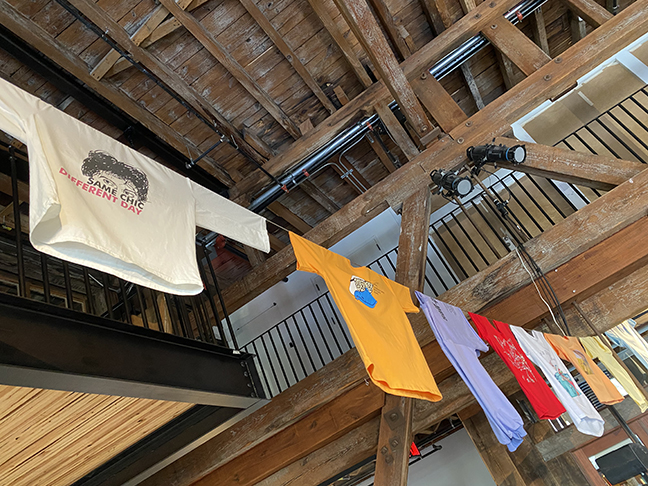
The show takes its title from a project by the collective Shanzhai Lyric. Over the past decade, artists Ming Lin and Alex Tatarsky have collected hundreds of T-shirts printed with bootleg logos and mangled English slogans (“Same Chic, Different Day”), the kinds of things you might find on Canal Street. (“Shanzhai” is the Chinese word for bootleg.) Several dozen colorful shirts hang like laundry on clotheslines sweeping in arcs across an upstairs balcony. When you spot an error, your eyes light up. The mistake is the garment’s appeal. The artists have strung together all the words to create an epic poem, and it’s this book you can order on Pioneer Works’ website. (It won’t tell you it’s backordered, but I’m telling you it is.)
 The contrast between the handmade and the mass-produced runs through many of the works on display here. On the upper floor, CFGNY (Concept Foreign Garments New York), a New York art and fashion collective, transforms a gallery into a room that feels overwhelmingly brown, with a slightly padded quality.
Closer inspection reveals it’s all cardboard. It’s like standing inside the same kind of box your clothes might come in. Intricate cardboard frames house huge vivid color fashion photographs of the collective’s latest collection shot in Ho Chi Minh City. One image shows a young man standing against a surreal acid-yellow swan-covered lake, wearing a sky-blue nylon jacket and baggy plaid shorts. In another, a woman in black high-heeled sandals shrugs off a shiny raspberry-colored suit jacket.
Nearby, mannequins styled by Juje Hsiung display garments by Asian designers. It’s a nice display, but not unlike anything you’d see in a high-end department store.
There’s more to consider downstairs, where artist Chang Yuchen, working under the moniker Use Value, presents fragile, colorful garments hanging from heavy wooden two-by-fours. These are less something you could wear than an idea of what a garment is, like a two-dimensional drawing made in fabric, sometimes with frayed edges and loose pieces of thread. Each is priced according to the value of the artist’s labor, the arithmetic worked out in pencil on small slips of paper displayed nearby. It raises interesting questions about how costs are determined and what we’re willing to shell out for something and why.
Dotted around this display are clusters of sugar cane sculptures by artist Serena Chang. Their leafiness well mimics the real thing, yet their metal armatures are covered in what looks like stretched pantyhose—hosiery manufactured by a company her father founded after emigrating from Taiwan to the United States. The longer you look at these, the more you appreciate their craftsmanship and artistry, including their intricate metal bases.
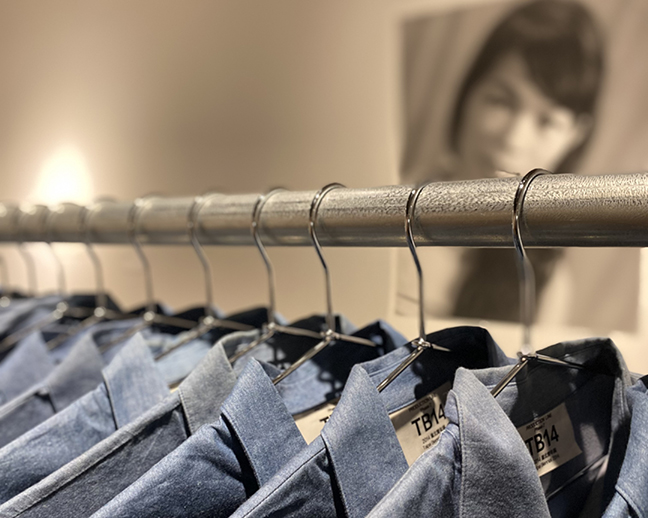
The emotional center of the show is Huang Po-Chih’s “Production Line—Made in China & Made in Taiwan.” A row of nearly identical denim shirts, in subtly different shades of blue, hangs beside large black-and-white matte photographs that put faces to the garment industry’s often anonymous labor. Huang enlisted his mother and her former colleagues to make these shirts. These women lost their jobs when the garment industry moved from Taiwan to Shenzhen. In one image, a woman smiles gently, the frizziness of her hair belying the hecticness of her working day. In another, a woman stands with her back to the camera, her hair pinned up and a tape measure around her neck. The scale and simplicity of the display—the photos are unframed and simply tacked to the wall—adds to their power.
The workers called themselves “Blue Elephants”—a wry nod to their swollen legs and denim-stained hands. Nearby text from Huang’s series “The Blue Skin” describes the vest his mother wore to work every day, which she altered over the years to fit her body perfectly: “After ten years, the vest seemed fused with her skin. She would take this blue vest with her to work, where she had to shapeshift, to turn into a different kind of creature.”
Clothes allow us to shapeshift as well. It’s not too often we’re urged to reflect on their makers or how they make it possible for us to put on things we choose to show the world who we are—or who we want to be. A show about invisible labor—in a place that makes its visitors feel invisible —is something to see.
“The Endless Garment: Atlantic Basin” runs through April 12, 2026, at Pioneer Works (159 Pioneer St., Brooklyn); 718-596-3001; pioneerworks.org. “The Endless Garment” poetry book can be ordered through its website (store.pioneerworks.org). When it will arrive is one of Pioneer Works’ many mysteries.mysteries.