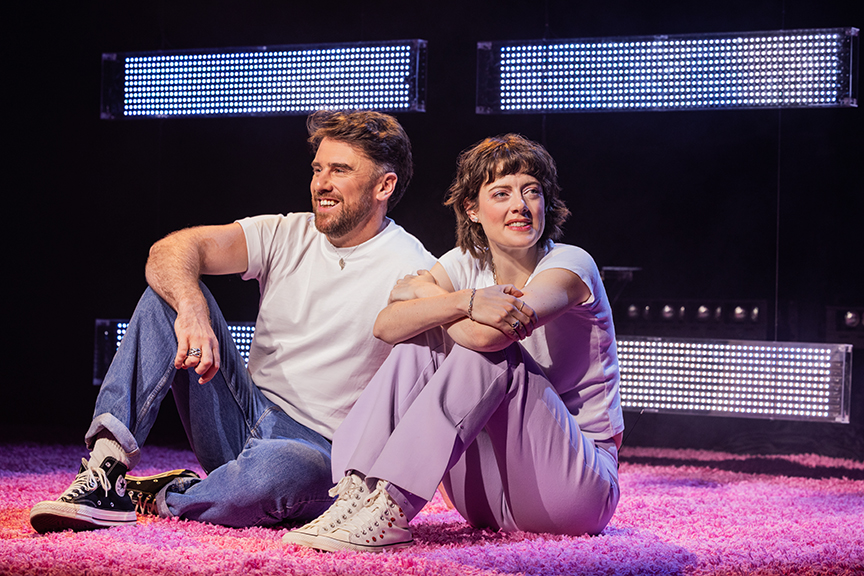
It’s almost inevitable. At each performance of Heartbreak Hotel, a theater piece by New Zealand playwright and performer Karin McCracken (co-created with director Eleanor Bishop), someone is likely to show up expecting a show about Elvis Presley. Instead, they find themselves immersed in a semi-autobiographical performance experience investigating the agonizing (and often prolonged) psychological and physiological effects that occur following a romantic breakup.
In the show, McCracken portrays the leading character (based on herself), playing opposite fellow Wellington actor Simon Leary. The staging is presented in NYC by a company called Occasional Drawl. (It continues at the DR2 (Daryl Roth) Theatre, through April 19.) In a recent Zoom chat with these two actors, McCracken spoke of those misinformed theatergoers: “It’s an extraordinary moment for me when I see them realize [that Elvis] is not what they’re getting.”
Such audience members tend to stick it out for the rest of the show, however. And, according to Leary (who plays an assortment of roles in the production), they “for the most part turn out to be delighted.” Although Heartbreak Hotel deals with cataclysmic breakups, it’s also designed to be informative and entertaining.
Also… Presley’s 1956 hit song “Heartbreak Hotel” is performed in the show, along with other anthems of breakup woe. But McCracken–who sings the achy-breaky numbers and who learned to play the synthesizer expressly for the production–told me that she in no way thinks of this show as a “musical.” She refers to it as a “play with songs.”
“Even calling it a play is somewhat misleading,” she added. “I would consider it contemporary performance. It’s definitely not performance art. It’s definitely, definitely not live art. It’s not quite a play, but it looks like a play.”
She’s aware that the label contemporary performance is “just two words that mean very little, stacked up against each other.” But it’s the best description she has found so far.
Devastation in Loveland
A decade or so ago, McCracken met Eleanor Bishop after Bishop returned to NZ from the U.S., having completed a master’s program at Carnegie Mellon. The two discovered that they shared similar artistic sensibilities. They began working together in 2017, forming a company called EBKM. One of their most successful shows has been Yes Yes Yes, a play for young audiences that deals with sexual consent. Another offering was Gravity & Grace, a large-scale project in which both McCracken and Leary performed. Heartbreak Hotel premiered in Wellington in 2024 and has since appeared at the Edinburgh Fringe Festival (where Bishop and McCracken were introduced to the Occasional Drawl team). The production has also traveled to Melbourne and London. Later this year, it will play in Toronto.
The breakup that inspired Heartbreak Hotel had hit McCracken hard. Considerable time passed before she could even think about writing about it for the stage: “If I had tried to write this…three years earlier, I would have been sent to an asylum.”
The show has a somewhat unusual format. It consists of three rather short acts, the first two of which contain brief sketches and monologues in which the physical and mental effects of heartbreak are explored in detail. The breakup scenario based on McCracken’s own experience is saved for the third act. McCracken explained that she rejected a linear format for the show because her own experience with romantic grief was full of stops, starts, and reversals. She would imagine she was finally “out of the woods.” Then–months later–she’d realize she was still reeling.
As for putting the story of the breakup at the show’s conclusion,” she explained: “For me it was like in a scary movie, when you don’t see the monster ’til the end.”
But there was another reason for examining the particulars of the breakup last. She wanted the play to include soothing, funny, and otherwise accessible elements, and she didn’t want to “frontload” the show with painful and depressing ones.
Leary spoke of yet another angle: The play is more “conceptual” at the start, and audience members thereby feel they have “permission to layer their own stuff” onto the text: to see themselves in the show.
The science-y bits
Originally, McCracken and Bishop hoped to explore both the scientific and the literary and artistic responses to heartbreak. But they needed to shorten the script to meet requirements of the Edinburgh Fringe, so much of the literary depiction of heartbreak was dropped, including a three-page monologue that McCracken composed and Leary memorized, describing the jilting of Miss Havisham in Charles Dickens’s Great Expectations. (Leary said that he retained the monologue for personal use as an actor’s “warmup exercise.”)
The artistic responses that McCracken and Bishop did retain were the musical ones: The show features a variety of songs that bemoan lost love. Said McCracken: “I think music really goes to the center of heartbreak…. No one, I think, has done better than the musicians in tackling that as a subject.”
As for descriptions of the mental and physiological effects of heartbreak–what McCracken and Leary call the show’s “science-y bits”– they are a significant part of Heartbreak Hotel’s dramaturgy. McCracken’s character describes how the fear center of a heartbroken person’s brain (the amygdala) instructs the nervous system to release a fear hormone (norepinephrine). The body’s monocytes (compared by McCracken to “watchmen”) then help instigate a “fight or flight” response, which produces high levels of inflammatory proteins. The sum of all this makes the human body vulnerable to viruses. No wonder people become not just melancholic but also physically ill following a breakup.
“I wanted to learn about the physiology of heartbreak because I had felt it in my body so profoundly,” McCracken said. She cited a scene in the production in which the protagonist goes to a doctor and requests an ECG.
“And I really did that. I was, like, something’s wrong in here.” The physician, however, told her that she had not had a heart attack.
“What I’d felt was that my body was really disproportionately responding to what was happening—in terms of actual risk to me, or my safety. It was so out of whack, and I was fascinated by that.”
Leary was particularly impressed by a phenomenon described in McCracken’s script as the “awe” experience. As the protagonist in Heartbreak Hotel explains: “Awe makes people feel small and connected to the rest of the world. In that way, it provides healthy perspective, which is very useful for people who are heartbroken. It doesn’t diminish your own self-esteem, it just makes everything else seem more important.”
Leary elaborated on this: “When people are really going through something in their life…there’s a human desire: I need something bigger than myself. Or I need to go somewhere where I’m not known by anybody. Or I need to go into the desert and take ayahuasca. Or I need my brain to move beyond this space that it’s in right now.”
Content versus form
As our Zoom chat concluded, I asked what the EBKM team would say to someone hesitant to attend their show because they don’t care to experience its downbeat subject matter–or, perhaps, relive traumatic things they’ve endured personally. McCracken said she would not presume to tell someone what to attend and what to skip. But she also feels the essence of this show encompasses more than just its textual content:
“There’s a risk in culture today that everything gets boiled down to content. But there’s so much to enjoy in form and there’s so much to enjoy in experimentation. And that lives quite outside of content. … The experience of the play is greater than the sum of its parts. I would say, ‘Don’t be so focused on content. I bet you’ll have a good time.’”