
At a concert in a church in June 2025, singer-songwriter Suzzy Roche mused on the nature of live performance. “Maybe this will be seen as something weird and strange in the future,” she wondered, “Something only a few people do and go to and see.”
Such questions about modernity abound in today’s culture as society stares down anomie, warfare across the world, and political turmoil. And perhaps no play of the past year has raised more questions about the nature of international relations, race in America, and the end of a political age than Ro Reddick’s Cold War Choir Practice (CWCP), a play with music which had its debut at the Wild Project in the East Village, produced by Clubbed Thumb in collaboration with Page 73, and has since come to MCC Theater in Hell’s Kitchen. The play is about many topics: Christmas, familial love, disco fries, cross-cultural relations, and the military-industrial complex, among other things, and stars Suzzy Roche!
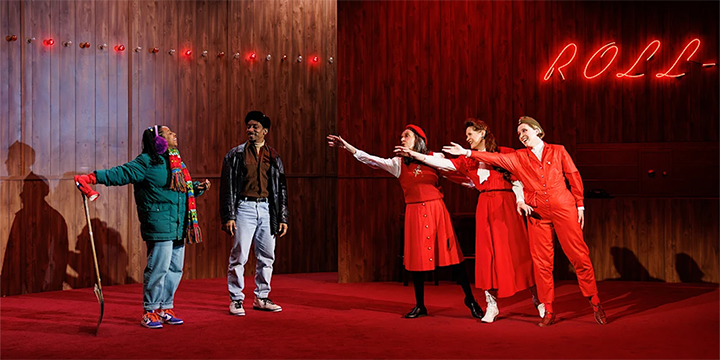
Set during the final years of the Reagan presidency, when it looks like nuclear Armageddon might not happen due to a treaty between the US and the USSR, a series of plots ensnare a skating rink in Syracuse and the family that runs it. At the center of everything is Meek, a tweenager who wants to stop nuclear Armageddon with the sound of her choir’s voices, although she herself is also building a fallout shelter in her father’s office, just in case.
Playwright Ro Reddick drew heavily on her childhood to write another one of what she describes as her forte—”Off-kilter comedies; the theme songs to your late capitalist nightmares.” Ms. Reddick sang in a choir in the fading days of the Cold War, singing songs of peace to inspire the USSR to not set the world on fire. “That’s a play,” a friend said when Ms. Reddick recounted the experience for them, setting the stage for what eventually became CWCP. The eponymous choir practice features heavily in the play, with some of the first seeds of Meek’s alienation being planted with the revelation she is the only Black girl in her choir.
Ellen Winter has one of the most intensive roles in the play: stage crew, tech, actor, musical director, and orchestra all rolled into one. Despite boasting an impressive theatrical career, Winter admitted it was the most intense role they had done to date.

Tony-nominated director Knud Adams brings the play together, juggling its many disparate elements to merge them into a coherent commentary about power. Indeed,Reddick said, “Every element in the play is me exploring power, autonomy, and belonging from a different angle.” Power drives all the interactions in the play, and its transition from one person to the next—first in the hands of a cult operative, then with Meek’s father the next moment, then with the president, then in Gorbachev’s hands, and so on and so forth.
The driving force of the play lies behind the Soviets, who want to determine Reagan’s sincerity in a nuclear disarmament treaty, and the military-industrial complex’s cult, who hopes to sabotage the treaty to continue selling arms to the US government. Reddick stated, “Both the Soviets and the Americans are portrayed as strong political forces with their own interests and agendas. Portraying one as the good guy and the other as the bad guy doesn’t serve the play and what it’s interested in exploring.”
She added that, “While I think the play is a way for me to process current anxieties about the state of the world, and to reflect back on my own coming of age, I don’t think it’s trying to reflect modern American-Russian relations.” However, Russia is portrayed sympathetically in the play insofar as only wanting to determine Reagan’s sincerity—they want the same peace the Americans want. It’s a comforting thought that one’s opponent wants the same peace one oneself wants, however much Russia today may appear to want the contrary.
These themes of power all tie into the nature of institutions larger than a human being can grasp or affect. Most Americans have little say in the country’s foreign relations, even as those relations increasingly resemble indiscriminate bombing. The play expertly captures that feeling of powerlessness in the character of Meek’s father, Smooch, a former Black Panther, who resents the US government for its many slights against the Black man and even sees the USSR sympathetically himself because at least they, in his own words, care about their own people.
One of the most unique parts about CWCP is that it is neither a straight play nor a musical, but a play with music. Reddick said that a play with music is a “wonderful container with no rules. You can decide how music will be used and that can change throughout the piece—that’s where Cold War Choir Practice sits.
Musical director Winter spoke on this, saying, “I think there are a lot of differing opinions on what makes a musical and what makes a play with music. I gravitate towards work that pushes our binary thinking, especially around how we define ourselves and our art forms, so I love that this show exists in such a liminal space.” However, Winter added, “This show would not exist without the music—it’s the spine of the show. From my place in the booth it feels like a musical.”
Like with one of the most iconic plays with music, Bertolt Brecht’s Threepenny Opera, the music in CWCP serves to shatter the fourth wall. Christmas songs about nuclear Armageddon smash the viewer out of their complacent theater-goer mindset and remind them of the stakes of the play, while songs about stopping nuclear Armageddon with the voice of a child satirize the saccharine nature of much of the politics of the Reagan years. In this way, Reddick skillfully subverts the norms of traditional Broadway theater by transforming music from something comforting or entertaining into something disturbing and galvanizing.
The constant music in the piece is buttressed by the eponymous three-woman choir, who aside from serving as the choir in the play also function as a Greek chorus. They also have their own individual roles in the show.
“I describe the choir in the text as a spooky organism that holds the strangeness of the world and its darkness,” Reddick said.
Cold War Choir Practice is about many things, from the nature of power to the dynamics of diegetic music to how to tell apart the roles each member of a three-woman choir play. At its core though, it is about people coming together and overcoming their differences, whether those differences be familial, as is the case with Meek’s family, or international, as is the case with the Soviets and the Americans. The enemy of the play is one that wishes to profit from the conflict, and has no ideological concerns.
As the military-industrial complex rubs its hands with avaricious glee while leering at the war in Iran, media tackling it is needed more than ever. (Reddick declined to comment on whether she believes the current military-industrial complex is involved in behavior as cultic as depicted in the play.) In CWCP, the power of family and love is instrumental to combating the fell designs of the anonymous manufacturer power players.
Whether love will successfully grind the war-profiteering juggernaut to a halt in real life remains to be seen.
Cold War Choir Practice Through April 5 at the MCC Theater, Manhattan; mcctheater.org. Running time: 1 hour 35 minutes.