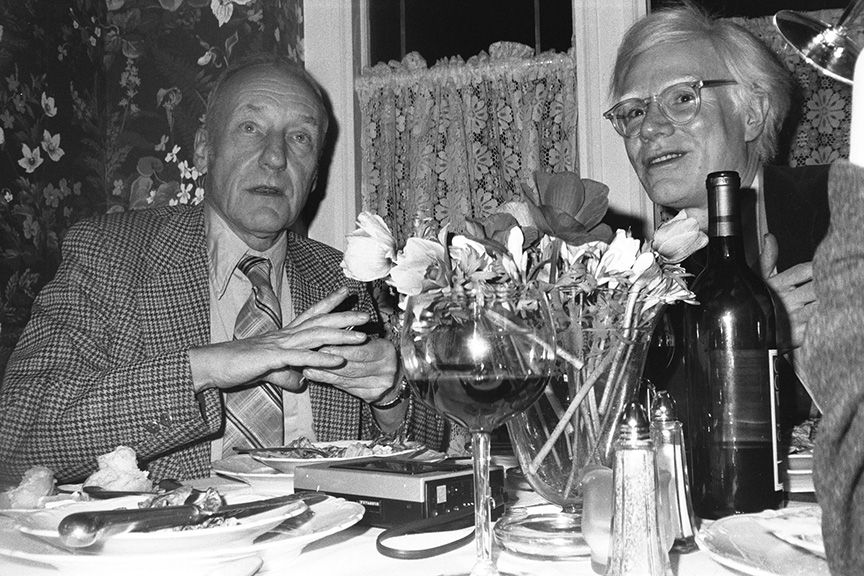
Once I stood on a rock in Manhattan’s night with everything to come and death out of sight, listening to the terrifying music of Venus in Furs, the biting satire of William Burroughs reading “Thanksgiving Prayer” to 10,000,000 people on T.V. And I recall Muhammad Ali asking me, “To take my message to the white longhairs in the colleges”; William putting his arm around my shoulder at 17th and Park with the immortal words, “It’s all up to you now, Victor”; Debbie singing “Victor” on Blondie’s “Eat to the Beat”; The Magic of Marcia Resnick’s voice; Andy Warhol writing in Exposures, “Victor Bockris is a brilliant young writer who has more energy than anyone I know. He types like Van Cliburn plays the piano. He’s always tape recording and taking pictures”. And above all I recall the romantic agony that is the source of all American art.
Dear Miles (in London), William (Burroughs) has just been here for a week and that was quite a scene. They came in last weekend. James calls me on Monday morning and says, “Well I know you want to give a dinner party how about Tuesday or Friday?” I say, “Well Tuesday at Jeff Goldberg’s place would be great.” So, we have a great time Tuesday. Jeff cooks an excellent dinner. We inaugurate a new club called The Corks. Anyone who floats is a cork and you’re out of the club when your cork can’t stay afloat any longer. This is all based upon the idea that corks never sink. And we in fact test the idea out. Jeff gets a bowl of water and we all put our corks in it and watch them float. Bill smiles in a malign manner as he pokes at his cork. In the middle of dinner William announces that New York’s famous restauranteur Mickey Ruskin had died the previous day. I jump up from the table and cry out “No! No!”
Well, Yes, Yes, I’m afraid it’s true. William had had dinner at Mickey’s One University Place on Sunday evening with three friends he explains and Mickey had come over to their table and thanked Bill for the copy of his new book Cities of the Red Night. Bill said he looked pretty bad, grey and full of junk, so we all nod knowingly and say oh dear another OD. Well, according to William, Mickey had taken a two week vacation in the Caribbean and sort of cured himself, but then when he’d come back somebody offered him something and Mickey forget that his tolerance had been lowered or so it seemed. Unless you’re there nobody really knows how anybody dies.
On Wednesday night I went to Mickey Ruskin’s wake. Paul Morrissey stood to my left, Larry Rivers to my right, Dennis Hopper, Phillip Glass and a hysterically weeping Rene Ricard surrounded me. The joint was jumping,
Ever since John Belushi’s death in March 1982, Death has come to our cultural capitol of the world smashing through the windshield of my car. I was in a blackout at the party for the premiere of Jim McBrides remake of Jean Luc Goddard’s Breathless. Have blacked out most nights recently. Don’t get/too brutalized/by New York.
Sometimes walking home after a night in Marcia’s bed, I think of Manhattan as a sunken ship — the lost city of Atlantis — and that none of us are really capable of walking on water and this is all a dream. Interview Editor Robert Hayes, who once saved my face, was dying. Chris Stein, with whom I wrote and designed Making Tracks: The Rise of Blondie, was on the death watch at St Vincent’s hospital. Lester Bangs died the day after Debbie, Chris and I published Making Tracks. My mother was dying of cancer in England.
Sterling Morrison was staying at my place on Perry Street for the weekend. I picked him up that Friday afternoon from the Riviera Café in Greenwich Village. I thought it was a weird place to meet considering this was where in 1968 Lou Reed destroyed The Velvet Underground and Sterling’s life by making him tell John Cale he was out of the band an hour before they were leaving on a tour. After working with Sterling over the phone on the Victor Bockris & Gerard Malanga book, Uptight: The Velvet Underground Story this was the first time we’d met. The book’s editor Miles was also in town.
That night Miles, my girlfriend Price, Walter Steding, Sterling and I walked down Hudson Street to a party at Mick Farren’s house. On the way, I noticed that I had put each of my very cool brand new black boots on the wrong foot. Marcia was at the party. I persuaded her to come into the bedroom where people were leaving their coats and lie down on the far side of the bed to make out while I felt her up. After that, I got horribly drunk because in the bigger picture I could not get what I wanted. The next day I had one of the worst hangovers of my life. Hard to be polite to Sterl. A very sweet guy. Felt too boxed in by the shimmering shadows of death that swum around me wherever I looked.
Living in New York, where I walked daily past houses in which friends who are now dead once worked and danced had made me almost callous about death. After collaborating with the city as much as its population between those climactic years 1977-1982, when I put my ear to the ground on Perry Street all I heard was the terrible sound of chaos ringing like a black box. And just last week I felt at times suicidal on the London Underground. The best thing I can do is to write a really mad book about New York that would drive me mad to write and everybody mad to read.
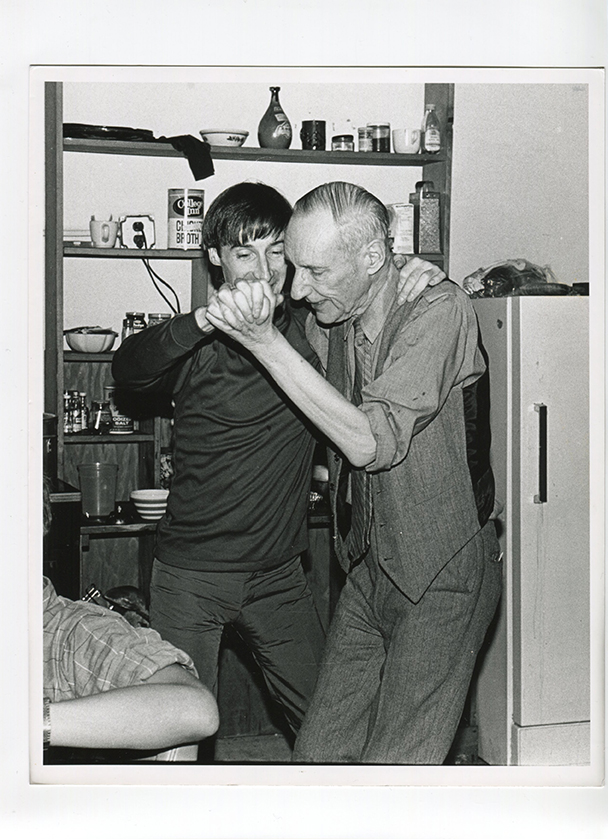
Last meeting with Andy Warhol 1983
As soon as I brought up the idea of writing a biography about him, Andy scurried into the kitchen at the Factory and began fussing over the sink like a little old lady. I ran in after him, grabbing the opportunity to pin him down alone and gave a nervous pitch.
“Oh, but there are so many other great kids.” He whined encouragingly, “Couldn’t you.. uh… do somebody else?”
“Oh…no…no…oh yeah…. I mean.. uh sure… I’LL BE WRITING ABOUT ALL THE KIDS!” I SPLUTTERED. Suddenly, business like, he cut out of the kitchen snapping, “Well, let me think about it!” Pursuing him now into Vincent Fremont’s office, where he sat cringing in a corner holding a large pumpkin on his lap, I yelled, “But, if you’re going to think about it, at least let me tell you what I have in mind!
“Oh no, no, no,” he shot back. “No, no, no. I don’t want to know anything about it.” And his face turned completely into the bright orange color of the pumpkin. Andy was, in truth, such a fantastical character I would not have been surprised if he had turned into Washington Irving’s Headless Horseman.
Later that afternoon, I sat with Andy at the alfresco Riviera Cafe in Greenwich Village sharing afternoon coffee with his photographer Christopher Makos and the painter Keith Haring while staring crowds clustered around us in the street. Andy kept moaning, “Nobody will buy a book about me. Why don’t you write a biography of Genet? He’s so great and he’s much more famous than I am.”
Instantly, everybody told Andy that he was much more famous than Genet.
“A lot of people are interested in your life story, Andy.” I told him. “It’ll be great.”
“No, they aren’t,” he said.
“Well, I’m going to do it,” I said.
“It’s a stupid idea,” he replied.
There was a pregnant silence. Then, while Warhol took photographs of the sky, Makos leaned forward, “Victor,” he said, “if you write the book, you won’t be able to come to the Factory anymore and Andy won’t be able to talk to you, but afterward, if it’s a good book, we’ll all love you just the same.”