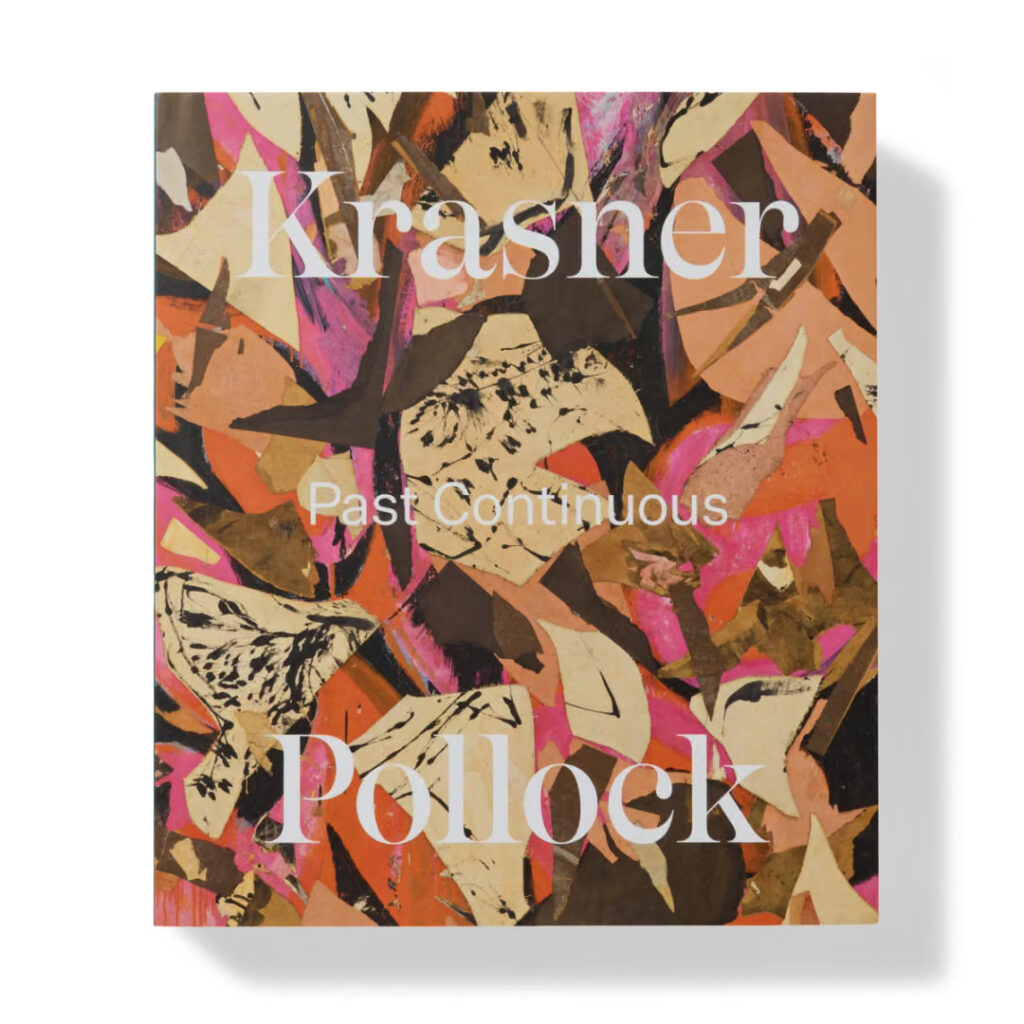
When I was in college and supposed to be doing coursework, I was often in the Gelman library reading Gertrude Stein, reading into her descriptions and statements in language and on time and tense. I encounter that again here with Lee Krasner’s masterful reworking of some of her own works, one of which also gives name to the huge new two-artist posthumous survey of her and her husband, who infamously predeceased her, Jackson Pollock: Past Continuous.
Though she came to it through acts of collage, as a description it runs truthful. The past is continuous. The present is presently becoming the past, as well as the future too will eventually become the past, and the past is truly continuous.
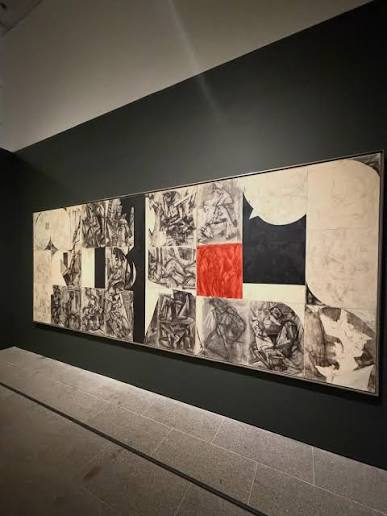
The Metropolitan Museum of Art’s new exhibition, Krasner and Pollock: Past Continuous, takes its title from a single painting: Lee Krasner’s “Past Continuous” of 1976, a triptych in oil, gouache, charcoal and paper collage, three panels running fifteen feet across. It is also the painting that gives this article its name.
The past continuous is the tense of something that was happening and has not finished happening. Krasner built the picture literally out of her own past: the collage is composed of charcoal drawings she had made decades earlier, in her student years under Hans Hofmann, cut up and set into the new work as blocks of color. Past drawings become continuous. The past goes into the present, and the present into the future, but it is the past that remains—everything is always becoming the past, and the past is always continuing.
That is true of paintings, and it is true of painters. Such as Ed Kerns and Jay Milder, stalwarts of the art world whose careers form an unbroken line back to the founding years of postwar New York art.
Milder’s line runs all the way back: to Provincetown in the summer of 1958, where he showed at the Sun Gallery alongside Red Grooms and Bob Thompson; to the City Gallery, which he founded with Thompson and Grooms and which moved downtown to become the Delancey Street Museum, an early site of the Happenings; to Claes Oldenburg, who had his first New York exhibitions there, and to Allan Kaprow, who gave the Happening its name.
And some things pass, as the present becomes the past. Milder died this year, on May 27, at the age of 92 and Ed Kerns on October 25 of last year at the age of 80 —the present tense of their long careers closing, even as the work continues in the continuous past they helped to make.
Krasner understood the tense before she named it. Twenty years after Pollock’s death, she took the drawings of her youth and made them new—looking back in order to move forward. She did not only title her collage retrospective reuse of paintings Past Continuous, but also worked across work titles such “Future Indicative,” ”Imperative,” and “Imperfect Indicative.”
“I am never free of the past,” she said. “I believe in continuity … the past is part of the present which becomes part of the future.”
So, now, is Milder. And so is Kerns, a bright, technological artist examining neural connections and the genome in plastic art, whose early training included a stint as an assistant to ab-ex and New York School titan Grace Hartigan.
The past is continuous. So is the creation which goes on.
The exhibition Krasner and Pollock: Past Continuous is on view at The Metropolitan Museum of Art (The Met Fifth Avenue, Gallery 899)now through January 31, 2027