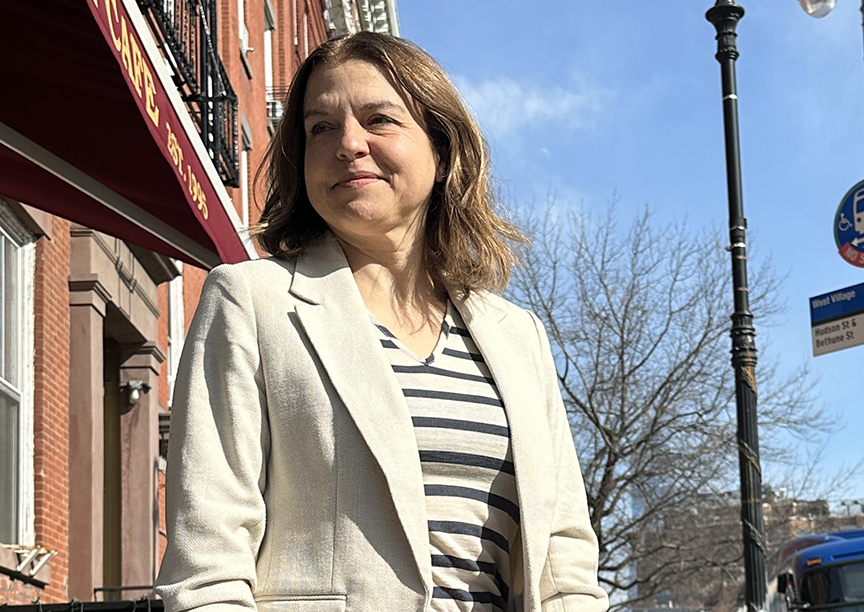
It is five o’clock, when I arrive at The Theater at City Tech. The New York City Housing Authority (NYCHA) annual hearing starts at five-thirty. After a quick press conference alongside Council Member Chris Banks who chairs the public housing committee of the city council, I sign up to speak, like a good citizen, like someone who still believes in sign-up sheets. The very friendly person tells me that I am number thirty-one. Fine. I’ve had worse numbers. I see many speakers sign up after me and I have experienced my share of wee-hours-of-the-morning hearings (City of Yes hearing, I’m looking at you!!) to believe that it is fully doable to let everybody speak. It is the mandate of the agency and at two-minutes per person, we should still be able to grab a post-hearing beer at a local bar.
The meeting starts promptly at five-thirty. But at seven fifty-five, the (symbolic) gavel comes down. Testimony stops after speaker twenty-six. I could’ve been a contender. Turns out I was just a rounding error.
The PNA, or, How to Improve Something by Refusing to Look at It
Chair Rubin opens the show pleased as punch: NYCHA’s Physical Needs Assessment is down. Numbers improving. Progress, he says, is being made. You probably remember the catastrophic announcements back in 2022. NYCHA needs had ballooned to $78 billion to maintain its buildings. The highest capital needs ever. A literal disaster. And now, this gargantuan number is finally coming down, Rubin says. He is like a thoroughbred ready to jump off the gate. The victory lap is on the horizon.
He leaves out the trick. Privatize a building to Section 8 through PACT/RAD or the Trust and it vanishes from the PNA count entirely. Not fixed. Gone. Off the books. The leaks, the mold, the faulty boiler, elevator, all may still be there. It’s just not your leak to count anymore.
Since 2022, NYCHA has converted over 31,000 units from Section 9 to Section 8. It is 31,000 units whose needs are no longer assessed in the PNA. And as the saying goes, you can’t improve what you don’t assess. In reverse, if you don’t assess it, it doesn’t exist.
Keep that in mind. It’s the same math that ran my evening. In NYCHA’s hands, improvement usually just means subtraction.
The Room
At seven-forty, Chair Rubin gets up and precipitately leaves the stage. Twenty minutes before his own meeting ends. The room lets him know exactly what it thinks of that, and it isn’t subtle. Members of the public scream: “Oh! Jamie? Where are you going?”. Meanwhile, more than once, ordinary residents have to shout from their seats and tell NYCHA executives, full salary, full pension, phones out, to put the phones away and listen to the people whose homes were the entire point of the evening.
Twenty-six people who attend the hearing in person get their two minutes before the gavel ate the rest of us. That includes Chris Banks, Chair of the Public Housing committee, who delivers a scathing indictment against NYCHA and its privatization scheme. He calls for a moratorium on conversions. The moderator, D’Andra Van Heusen-Thomas, nauseatingly tries to cut him off. He reminds her that as an elected official, he is allowed additional time. The board relents and he delivers the final blow with his last sentence: “Tonight’s hearing is an opportunity to examine whether NYCHA will pursue a path that truly protects residents and preserves public housing for future generations, or simply reconfirm what residents have said for years: that NYCHA needs new leadership and fresh ideas.”
Meanwhile, On LinkedIn
A week prior, Jonathan Gouveia, NYCHA’s former Chief Real Estate Officer, architect of the Fulton and Elliott-Chelsea demolition scheme, posts about the appellate division ruling clearing the redevelopment. Residents, he writes, were “co-architects.” The project will “restore the dignity residents deserve.” And the kicker, delivered with the total serenity of a man watching his own legacy compound from inside a Harvard executive-ed classroom: “the model works. Now let’s scale it.”
But wait?! Didn’t Gouveia hastily leave NYCHA mid-way through the bulldozer-crazed plan. No explanation given. When the architect leaves mid-way, it usually signals that the architecture was not so good.
I got a taste of the indignity myself. 145 minutes of sitting, and then Ms. Van Heusen-Thomas informing me and all who signed up after speaker #26 that the number was decorative. Mr. Gouveia wasn’t in the room for that part. He was busy “sharpening tools for his next chapter” as he wrote on LinkedIn. I was busy holding onto the number 31, which turns out to be a tool too, the kind that tells you, in writing, exactly what your testimony is worth to the people who asked for it.
The Room, By the Numbers
69 percent of everyone who managed to speak told them, in one form or another, to stop, including Council Member Chris Banks and the NY State Assembly Chair of Housing Linda Rosenthal. Not a fringe. Not a faction. A supermajority, achieved the hard way, one two-minute testimony at a time, and it still wasn’t enough to keep the meeting open past speaker twenty-six.
For the Record
Let the record show, since plain statements apparently now require a hearing of their own: I oppose the demolition and privatization of Fulton and Elliott-Chelsea Houses. I object to the FY 2027 NYCHA Annual Plan. I challenge the inaccuracies including the misleading data that no bedroom loss will be encountered post-demolition. The truth is at least 250 bedrooms will be lost and NYCHA did not properly disclose it to residents.
NYCHA has agendas. It has quorums, PNAs, minutes, and Chairs who beat the traffic. What it doesn’t have, not on July 29th and not for a while now, is the stomach to sit in a room until the public it serves has finished talking. An authority built to house people spent an evening demonstrating, with great procedural precision, exactly how much of us it could stand.
The number was: not one more past 7.55 pm.