
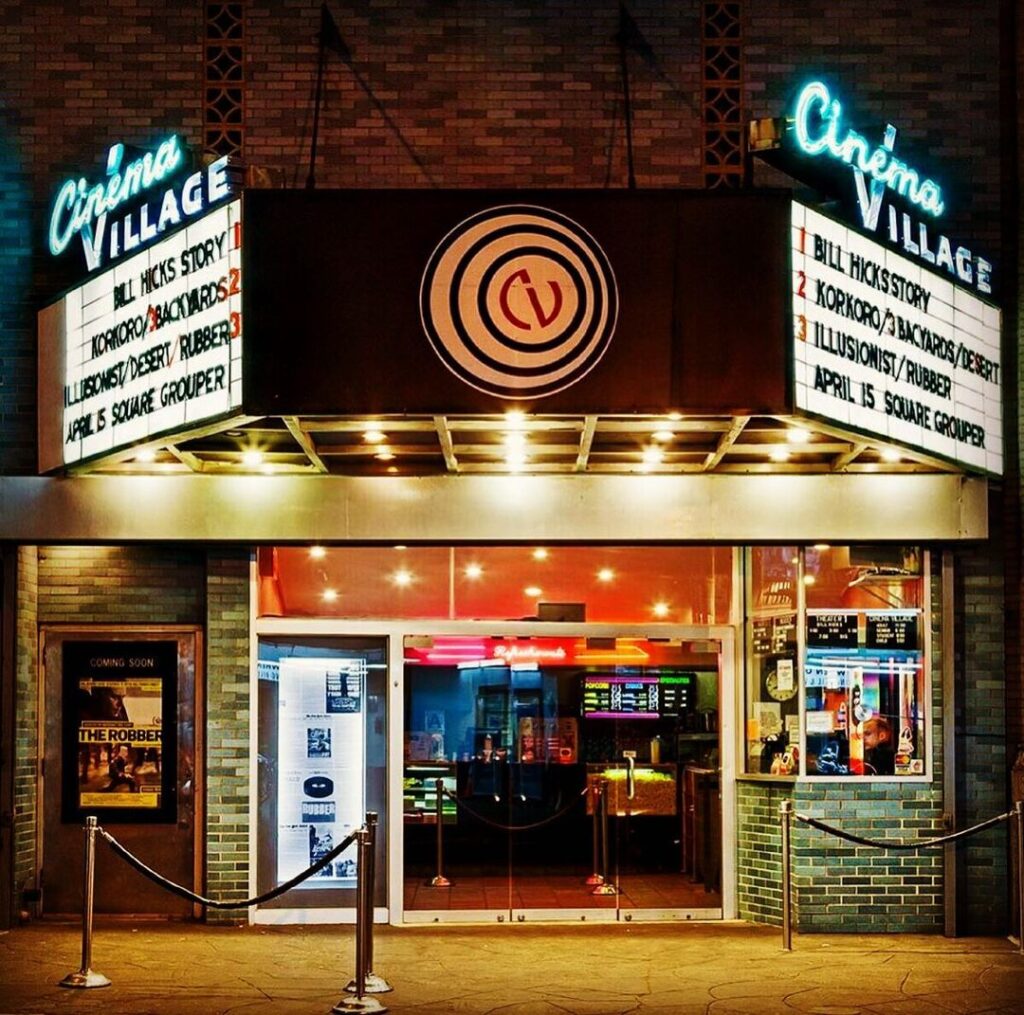
We Villagers have been watching our bohemian neighborhood character leach away for a very long time, but we remain blessed with movie theaters.
It’s true that many are just a memory (the Art Greenwich Twin, Bleecker Street Cinema, two theaters on Eighth Street, Theater 80 St. Marks, the Landmark Sunshine), but we are still richer than most neighborhoods in art and revival houses, including the Roxy, two Angelikas, Film Forum, IFC, Quad, and Cinema Village.
My husband and I have been regular moviegoers and movie boosters since we started dating during the Great Hitchcock Revival of 1984, when a romantic night out was likely to start with Szechuan food and move on to murder, probably starring Jimmy Stewart. We still make the rounds, seeing a mix of revivals, independent films, and the occasional blockbuster to keep a hand in the zeitgeist. Even Covid didn’t stop us: the theaters were empty, the air was actively circulating, and we tried to support the suffering owners.
We know the subtle distinctions of vibe at each venue. We smile at Film Forum’s cinephile reverence (where Mayor Mamdani, his wife and a retinue of NYPD security guys filed discreetly into the back row the night we saw Satyajit Ray’s “Days and Nights in the Forest”). We spend a lot of Saturday nights at the Angelika, once the hip new player in town and now just pleasantly lived in, with a down escalator that hasn’t worked in ages.
At the IFC we watch the annoying but oddly compelling soundless Q&A montage featuring all the indie darlings from Errol Morris to Greta Gerwig while waiting for the beautiful Zoetrope-inspired animated intro.
We note the slightly chilly feel of the Quad since it reopened under new management in 2017. Occasionally we get lucky and they’re showing something we want to see in the opulent main theater at the Angelika East, formerly a Yiddish live theater; it was the perfect backdrop for “The Brutalist.” And we shake our heads in wonder at the continued existence of Cinema Village, the little theater that could.
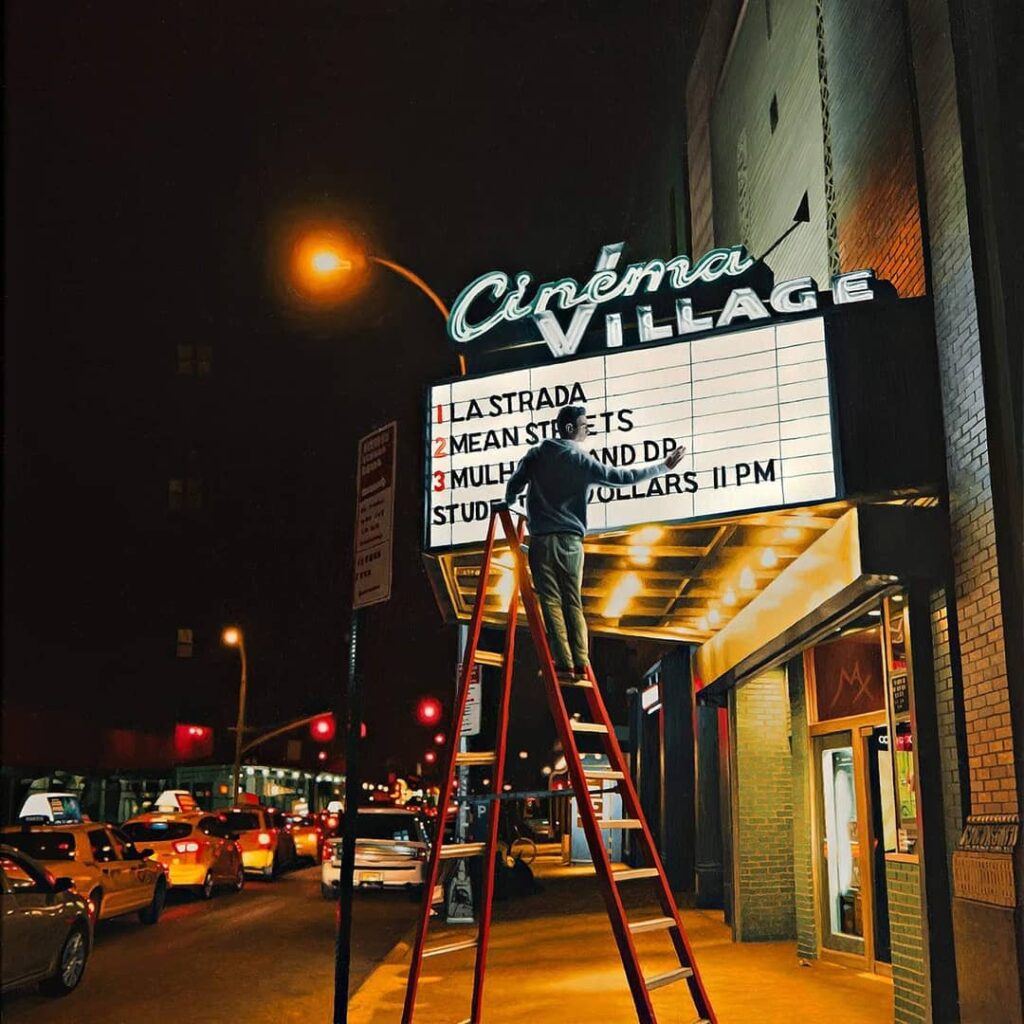
I decided to find out how Cinema Village, tucked into East 12th Street just west of University, does what it does. Tickets just went up after many years, but only to $14 for adults and $10 for seniors, students and kids. By contrast, the Regal multiplex at Union Square charges $20.49/17.99. The Angelika: $19/17.50. The Quad: $18/16. (This is not including the $2 or more all the theaters tack on for online purchases.). And it’s not as though Cinema Village, originally a firehouse dating to 1898, is grungy; it looks fresh and clean.
Sometimes the Village is still the Village, by which I mean full of unlikely and passionate characters driven more by love of what they do than by love of money. Nick Nicolaou, a low-key 68-year-old who lives in Forest Hills, is the unlikely force trying his damnedest to keep the theater going. He has traveled far to get where he is, having started life in a tiny village in Cyprus where his family of five lived in a three-room house and the local cinema was a warehouse with a projector.
In 1970, when Nicolaou was 12, the family immigrated to Queens. One day after school he took the subway into Manhattan and got off at the first stop: Third and 59th, stepping into what was then a wonderland of movie theaters: the D.W. Griffith, the Baronet and Coronet, Cinema 1-2-3. His first job was at the RKO 59th, where a classmate was an usher. He made himself indispensable. During his second year at Hunter College, when he was working and actually living for a time at the Griffith (which he says was cozy and beautiful inside), he was offered a job as general manager for a group of theaters including the Griffith, Cinema Village, and Cinemart in Queens. He dropped out of school, choosing instead an ad-hoc, on-the-job hybrid degree in film and business.
One of the many lessons he learned was that in those days, when people still watched their porn communally, the real money was in working at the “adult” theaters, many of them clustered around Times Square and often owned by the same people who owned the “family” theaters. With those earnings and an unexpected inheritance after his mother died, he began buying theaters, starting with the Griffith for $160,000. In 1983 he bought the Jewel in the East Village, known for gay porn. He didn’t judge. “The adult theaters were disgusting,” he says. “So I put thirty thousand into cleaning it up. Even those people deserve a nice, clean place. I took any money I made and expanded into more regular theaters.” He later converted the Jewel into a restaurant and apartments. By the time he was 30 he owned eight theaters.
Business was rarely easy. In the 80s the chain Cineplex Odeon, widely reported to be bankrolled by Seagram money, swam into town and swallowed up small theaters. We movie buffs took to calling it Cineplex Odious. Mayor Koch organized a boycott. Later, DVDs and in-home streaming chipped away at the more communal pleasure of watching movies in a theater.
Currently Nicolaou owns two other theaters: the Cinemart in Forest Hills and the Alpine in Bay Ridge, the oldest continuously running theater in New York City. He says the real foe is the City’s unfair property tax structure, which hits particularly hard at his big borough theaters. “I’m happy to pay tax, but the specifics of the property tax are highway robbery,” he says. “The Department of Finance has no common sense. All the neighborhood theaters had to shut down when they couldn’t pay the $320,000 tax when film rental alone can cost $65,000. I’m not asking the city to give me money, just asking to correct something that’s unfair.”
Of his three brick-and-mortar children he clearly has a favorite: the Cinemart, which was given to him by the bereaved widow of the previous owner, who also lost all her children and who took a strong liking to Nicolaou. “I love that place more than anything. Maybe because of my customers and their support. Civilized people, whether black, white, Jewish, whatever. It’s not near the subway so you have to walk. I can never close that theater.”
Cinema Village is the oddball of the trio: a tiny art house that’s been in business since 1964, in a movie mecca. It’s also an oddball among its local brethren. Nicolaou describes it as the only theater that isn’t subsidized in one way or the other. The multiplexes and even the IFC have deep corporate backing. At the other end of the spectrum are nonprofits like Film Forum. “I’m competing with billionaires and nonprofits,” he says. “I’m not angry and I don’t begrudge anyone. It’s a choice I made, and at the end of the day it’s good that we have all these different theaters.”
But he’s up against a lot of obstacles, including this maddening one: for five years the building has had scaffolding up against it, first on one side and then on the other, blocking the jaunty, historic neon marquee. (Notice the clever way the capital V of Village rises up to become the accent aigu on the “e” in Cinema.) It’s put the kibosh on lucrative, much-needed film and TV shoots. Scorsese, for instance, filmed his 2006 crime thriller “The Departed” there. Coldplay once paid $4,000 to perform a single show.
Cinema Village originally had one screen, but Nicolaou managed to carve a second one out of the balcony and a small one downstairs near the restrooms. In recent years he has positioned Cinema Village as the go-to Manhattan venue for film festivals, including the Big Apple, which is renting the whole complex for a week in November. The festivals are a financial boon, but they’re also a lot of work: up to 100 movies and five to six shows a day, with a projectionist in the booth at all times, labor not all owners are willing to take on.
The theater had a lucky break last year when Gucci chose it for the New York premiere of the short Spike Jonze film The Tiger, a spoof of the Gucci family designed to show off the designer’s new collection. It has a ton of star power: Demi Moore, Keke Palmer, the Edwards Norton and Harris, Ronny Chieng, and more. For the opening Gucci poured resources into upgrading the space, donating a set of directors’ chairs for Q&As and even replacing the carpet.
Another struggle: the theater is too small a player to get first-run art films, though he tries valiantly to work around this. “We don’t have the muscle, though we do get a lot of nice movies.” He has strong relationships with A24 and other creators. “They know we’re good at what we do. We reach out every Sunday, so that by the time the workweek starts we already know what we want.” He admires the new roomy reclining seats at the chains and wishes he could put them in. But they would vastly cut seating capacity, a deal breaker for filmmakers and festivals.
“Honestly we’re in survival mode,” says Nicolaou, “trying to minimize expenses and bring in some income.” The good news: “Except for when it was new, the theater is a much better facility than it’s ever been.” It’s small enough to run with a staff of two or three. He’s delighted by his current employees, including the woman who takes meticulous care of the place and the kid hired to work the candy stand. “He’s good and smart and has common sense, so I promoted him to supervisor,” says Nicolaou, as if describing his younger self.
Nicolaou is a savvy businessman who has done well for himself and his family, but the way he sings the praises of neighborhood movie theaters he sounds almost like a public servant. “It used to be an event to go to the movies,” he says. “You got on line in advance. Movie theaters give life and character to the neighborhood. I’m willing to compromise the way I live to keep the theaters going. They mean a lot to me.”
Long live the Village.
Note: To learn more about Nicolaou and New York movie houses through the decades, I recommend “The Projectionist,” a 2019 feature-length documentary, available on several platforms. Directed by renegade filmmaker Abel Ferrara, it’s mostly an extended interview with thoughtful, no-nonsense Nicolaou, complete with clips from vintage art-house porn, images of the defunct Third Avenue theaters, and even scenes of Nicolaou’s beautiful village in Cyprus.