Read the following sentence aloud: Merry Mary married hairy Harry. One of two things will happen: if you’re from most places, all your vowels preceding the “r”s will sound pretty much the same: like “air.” If you’re from New York City or a tri-state ring around it, you’ll use three distinct vowel sounds, as I do: a short “e” as in “pet” for Merry, a flat long “a” with that “air” sound (a diphthong, designated this way by phoneticians: /eə/) for both Mary and hairy, and a short “a” as in “cat” for married and Harry.
What a fascinating thing, accents. An inextricable part of ourselves, hard to change, a key to wherever we came from, even in an increasingly homogenized, interconnected world. I didn’t grow up in New York, but my family on both sides was from Staten Island, where the accent was schmeared on particularly thickly.
My parents talked about their good friends the Niedamans and the Silbasteins, and I had no idea until I was at least 10 that they were really the Niedermans and the Silbersteins. Those missing Rs strayed to places they didn’t belong, like the end of “soda,” or to grease the transition between vowels, like the way my father’s burger order included “a slice of roar onion.”
What a symphony of “a” sounds their mouths produced without a thought. In addition to the aforementioned straight short “a” as in “marry,” they had the exaggerated “aw” of “talk.” They also put the diphthong (think of Bugs Bunny’s “eh” before “What’s up doc?”) on certain short “a”s (grass, bath, photograph), but never the same places where non-New Yorkers use it.
In Norwalk, CT, my hometown, I was always attuned to a pronunciation tug-of-war. I sometimes felt that my town sat right on the border between New York and New England. Like my family, most of the Jews in town came from the boroughs of New York after World War II and brought their accents with them. Some kids took on the accent, but others didn’t. Me, I got roughly a third of it. Most of the other kids tipped in the direction of the harder sounds of New England.
This way of speaking in turn resembles the way people talk in a huge swath of upstate New York and the Midwest. None of this was simple, though. Most of my classmates flattened their long “a”s: America was “A-MARE-i-ca.” But they also tended to New York-ify their “aw” sounds: tawk and cawffee.
Further complicating matters, people would talk about “standard English,” the kind spoken on the news. But for a long time the three network anchors were Peter Jennings from Canada, where the long “o”s are as protean as New York “a”s; Dan Rather, who was pure Texas; and Tom Brokaw, a guy whose oddly unvoiced “l”s resemble, of all things, the Philadelphia accent and may be a regional quirk from his native South Dakota or a slight speech impediment; the Internet isn’t sure which.
My ear is clearly attuned to accents. I yell at the TV when non-New Yorkers put the diphthong on the wrong “a” and end up sounding more Bostonian than Brooklynite. My husband and I recently enjoyed the Pamela Adlon series “Better Things.” But the ghost of her character’s dead father would occasionally make an appearance, and I cringed every time because the actor who played him nailed the New York attitude and intonations but got the vowels so very wrong. Sure enough, the actor grew up in the deep South.
Recognizing accents and pinpointing when an actor has mastered one does not translate to being able to replicate them oneself. I do have in my repertoire a passable French (from years of French classes) and a generic US Southern (which I think most people can do). But I have never had faith in the nimbleness of my tongue or my ability to climb out of the box of myself and into someone else from another place and/or time. One of my favorite scenes in my novel is a conversation that takes place in a confession booth, but I’ve never dared tackle it at a reading because one of the characters is a Polish priest and I fear I would botch his voice.
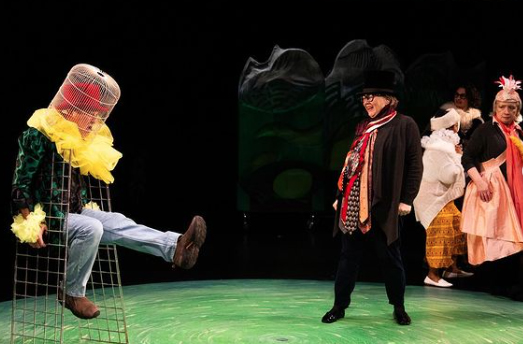
Then over the summer I took a theater workshop at Hudson Guild, as I often do. This one explored music in theater and was one of my favorites. Among other assignments, we were all sent off to find a song from a Shakespeare play to sing or recite for our final presentation. I looked at an array but none of them felt quite right (so many cuckolded husbands!) until I happened upon “Winter” from Love’s Labor’s Lost.
I fell in love with the world it creates: frozen milk in a pail, coughing parishioners drowning out the parson, a mysterious woman known as greasy Joan. The song felt Elizabethan while also oddly modern: full of sensory detail, not so different from a poem I might write here in the 21st century.
I recited it nonstop while going about my other business until I got it in me. Then I took a leap: I would do it with a British accent, though I had never done a British accent in front of anyone and I had not an iota of faith that I could pull it off. I did trust my own diligence, though, and knew I would at least do better than Dick Van Dyke’s famously awful Cockney in “Mary Poppins.”
I’ve been idly practicing my British for ages, mostly when the BBC News Hour (“knee-USE-oww” as the anchors call it) comes on the radio. I already knew that good accents don’t start with the pronunciation, but grow out of a shift in posture and attitude. To sound like a Brit I needed a new kind of formality and alacrity in my facial muscles, a crispness.
As I began practicing my song (When icicles hang by the wall and Dick the shepherd blows his nail…) I realized that a British accent asks even more: an almost aggressive biting-off of the ends of consonants, odd in a people known for politeness and indirection (I kind of rather like…). This alternates with a vigorous pushing out of vowels, all of it higher up in the face than I’m accustomed to, all the way to the nose, the words forming close to the front of the mouth with much more lip and cheek activity than my usual speech, which emanates from the nether reaches of my throat. I almost imagined a schoolmistress rapping me with a ruler to straighten the posture and engage the little-used muscles of my entire head.
Not only did I pull off the British accent in our rehearsal, by the time of the performance itself I had nudged it in the direction of Cockney. I was surprised how little extra effort it took to get a little “oy” into the beginning of “icicles” and to disappear the “l” in “milk.”
Just now, trying to break the particulars down, I read the poem aloud again, first in British and then in my regular voice. The contrast as I moved from the former to the latter shocked me, as if I’d taken off a whalebone corset and put on an old sweatshirt. I also noticed that “Winter” includes the line “a merry note”: the very same “merry” as Mary in the sample New York accent sentence, pronounced the same way; I didn’t have to alter my usual pronunciation one bit. I never drop my “r”s, but I suddenly understood the connection, however tenuous, between England and Staten Island. The Internet tells me the dropped “r”s (the technical term is “non-rhotic”) began as an affectation in England in the 18th century, one that never took hold in the rest of the British isles. Here in Noo Yawk the dropped “r”s read as the opposite of posh. But suddenly I felt the link between them, one that spread with merchants traveling between ports on either side of the Atlantic. There’s even a maritime link between the New York and New Orleans accents. It helps explain why real old-timers, my grandpa included, turned “Thirty-Third” into “Toity-Toid,” a sound that is no doubt also related to the Cockney “oy” on “icicles.”
Here’s a funny thing I can’t explain about New Yorkers in the present: they occasionally subvert their own accent. I’m not sure if they do it on purpose. Listen to Lin Manuel Miranda, Inwood native, saying “Alexander Hamilton.” The “a” in Alexander is a regular New York short “a.” But he gives the “a” in “Hamilton” the New England/Midwest diphthong, the way most of us pronounce “ham.” This makes a certain amount of sense, but I’m guessing he does it unconsciously, maybe an attempt at more standard English. Having grown up with kids named Barry, Carrie, Gary, Larry and Harry, I felt a little self-conscious about my outlier’s pronunciation. I even tried to use the “air” sound to match my rank-and-file New England-sounding classmates. But I just couldn’t do it; it made me feel like a phony. Over time I grew to like the way, when I open my mouth, a bit of my family’s deep New York history slips out.