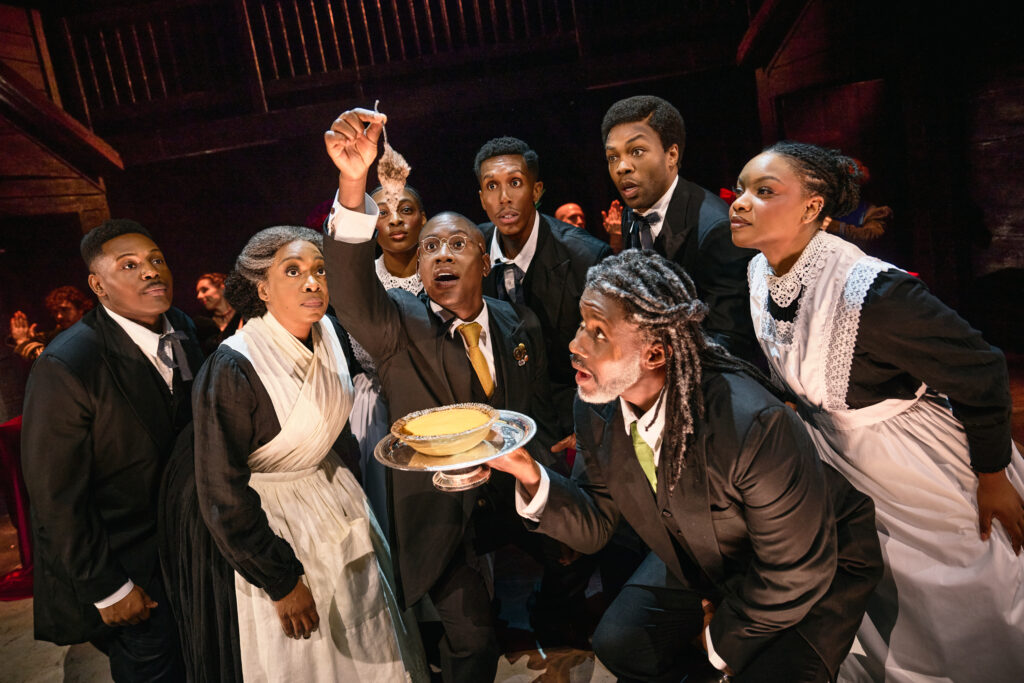
Set in an unnamed state in the American South before Emancipation, the mostly sung-through musical Midnight (at the Daryl Roth Theatre through January 3) tells a tale of forbidden love on a plantation owned by two brothers. One brother is surprisingly progressive, harboring what seem to be burgeoning anti-slavery views; the other is all about the status quo.
This new, large-cast musical, which overflows with song and spectacle, is the creation of auteur showman Todrick Hall. Along with his roles in Broadway shows, Hall is known for his many YouTube videos, his recordings, and his work as a choreographer (and sometimes judge) on RuPaul’s Drag Race. Midnight is his show from stem to stern. He is its librettist, composer, lyricist, director, and choreographer. And he also plays the starring role of “Rail,” a young man whose station among the enslaved people seemingly rises—until complications ensue.
This production has faced controversy throughout its development and into its run. Some have felt the storyline exploits Black trauma as entertainment. Reviews of the show have been mixed. That said, the preview performance I attended was met with vociferous appreciation.
Although Hall himself is Midnight’s main event, other cast members do have enough wiggle room to make an impression. One of them is Sidney DuPont, who in 2022 created the role of Washington Henry in Broadway’s Paradise Square, for which he earned a Tony Award nomination. In the years following that musical, DuPont kept busy. However, Midnight marks his first return to a role in a major New York production. (He did appear in a non-musical play called Chiaroscuro at the Flea Theater in 2025.)
A plenitude of music
In the first half of Midnight, DuPont portrays an enslaved man named Squeak, a supporting character. In the latter part of the show, however, he assumes a much different role—and a rather more prominent one. (Producers of the show tried to keep the nature of a couple of surprises—including a big conceptual switcheroo at the top of Act 2—under wraps. Now that the show has opened, those surprises are out of the dramaturgical bag. But I’m avoiding spoilers here.)
Midnight’s long developmental period included a production in London in 2024. DuPont, along with many of the show’s other current onstage players, came aboard more recently.
Before Midnight, he had met Todrick Hall socially and had seen a solo show of his at Webster Hall, but he did not know him well when he took the job.
“I knew of his work, and I was so moved and impressed by what he’s done over the years. … He’d done a bunch of Broadway shows. And a few of those shows I’d done down the line—on national tours and stuff. So, I kind of had the idea that he was a true theater nerd like me.”
The first day of rehearsals for Midnight was “quite a shock” for DuPont. The sheer volume of musical content made him think, Oh, it’s operetta!
“I had to buckle my seatbelt and get ready to go over countless voice memos…sitting by my piano and plunking things out.”
When I asked him about the personal challenges that the job presented, he said that, besides the abundance of music in the show’s two-and-3/4-hour running time, the production’s shift-of-gears at the top of Act 2 stood out. However, this factor was more “gift” than “challenge.” He explained that, in the course of a performance, an actor doesn’t always get to “stretch their ability.” But the duality factor in Midnight stretched him—and then some. He worked to find distinctive approaches for each of the two acts, modulating his voice and changing the way he moved after intermission.
Theatrical déjà vu
As work on the project progressed, DuPont often found himself reminded of his five-year stint as part of the team that developed Paradise Square—also a musical about race relations in the mid–19th century.
“When I realized that we were in 1863 again, I was, like, I know this era like the back of my hand. … I was nervous, to be honest, to touch this time period again. It’s not an easy time period [for] a Black person to touch on.”
There are significant differences between the two musicals. Most notably, Paradise Square takes place not, like Midnight, in the Deep South, but rather in NYC, where Black residents lived side-by-side with Irish immigrants.
Still, similarities between the two storylines kept popping up for DuPont. He cited a “beautiful song” from Act 1 of Midnight, sung by castmate Ayana George. The number—called “The Dancing One”—tells the story of a Black boy who goes out dancing with “the wrong girl” and winds up being killed for it. When he first heard the song, he couldn’t help but think of his Paradise Square character, Washington Henry, and the backstory he had imagined for Washington.
Paradise Square wasn’t Philadelphia-born DuPont’s first Broadway show—he’d joined the NYC company of Beautiful: The Carole King Musical back in 2014. But PS was the show that “meant everything” to him. Originating a role in a Broadway production was an honor he took seriously. And the Tony nomination provided a big boost to his confidence.
“Suddenly, your idols—the people you’ve looked up to for a very long time—see you. … I felt this overwhelming sense of gratitude. … They say it takes 10 years to be an ‘overnight success.’ I would say it takes about 20.”
Nonetheless, Paradise Square was a mixed blessing, with no shortage of turmoil—most prominently centering on producer Garth Drabinksy, who was unable to honor the terms of an Actors Equity contract and was eventually placed on a “Do Not Work” list, forbidding him from hiring Equity actors. (This was not, by the way, Drabinsky’s first financial scandal in the theater industry. He’d been sentenced to prison in 2009 for fraud and forgery.)
The show also endured canceled performances because of COVID.
DuPont says of Paradise Square: “It was “either the best of times or the worst of times—there was no middle ground. One day you have Chita Rivera…telling you you’re the best thing since sliced bread. And the next day, some other drama has manifested itself.”
He remains close with members of that show’s cast, who continue to maintain group text threads and sing “Happy Birthday” to one another. Some members of the PS cast, such as Kennedy Caughell and Dwayne Clarke, have wound up performing with him in Midnight.
The art of character creation
DuPont won’t have to worry about downtime after Todrick Hall and the Midnight company take their final bows. One project that he developed in the gap between Paradise Square and Midnight is a one-man show called I’ve Gotta Be Me, a musical tribute to Sammy Davis Jr. (whose centenary was marked last year). Davis has long been a kind of beacon for DuPont—someone whom he has felt an affinity for since childhood. Dupont has already performed the show in Chicago. Dates are set for Houston in January.
There’s also another new book musical in the offing, called King of Harlem. Having originated a role in Paradise Square, DuPont is keen on helping to create other new plays and musicals.
“I don’t want to say I’m opposed to jumping into shows that already exist—the Hamiltons and the Wickeds. I will take it. But, at the same time, I get a lot from creating new characters. I really got into the industry to do that. I feel that’s where my artistry is most celebrated…and where it is most vibrant.”
The Daryl Roth Theatre is an off-Broadway performance space at 101 East 15th Street, at the northeast corner of the intersection with Union Square East, near Union Square. Midnight opened September 25 and runs through January 3.