This month’s Village-based scoops surprise me. I’ve heard and seen works by John Cage, Allen Kaprow, George Maciunas, and Naim June Paik, but I had barely seen anything by Alison Knowles. Have you? Read on for this and for surprise scoops at the end.
Alison Knowles is the only female and the most New York-centric founding member of Fluxus, an interdisciplinary, international art collective. Alison Knowles: A Retrospective (1960-2022) at the Grey Art Museum, 18 Cooper Square, is free daily through January 30, 2027 starting at 11 am. Closed on Sunday, Monday, and major holidays. Don’t miss it and take your time there!
Born in 1933 in Scarsdale, Knowles lived at 423 Broadway near Canal Street between 1956-59, moved to Chelsea for seven years, then lived in a loft on Spring Street for the rest of her life, dying at home at age 92 in 2025.
By April 1958, at around age 25, her first solo abstract painting exhibition was at The Nonagon Gallery at 99 Second Avenue. Knowles had graduated from Pratt and met Dick Higgins at a party in 1959. He was a student of John Cage’s at The New School. The three became lifelong friends.
By 1962-63, Knowles was touring Europe with George Maciunas and the Fluxus group. They incorporated words, music, and amplified everyday sounds to create sound “scores” unlike traditional music and invented other provocative art experiences. Fluxus expanded and transformed notions of art-making from painting to projects involving printing, mixed media, music, dance, food, and performance.
Knowles’ Make a Salad performances in different locations from 1962-2008 used sound amplification, theater antics, and food to create edible art. including chopping salad ingredients. Another event was having people take off their shoes to discuss their merits. As she began working at various high end art production jobs, Knowles used silkscreen (like Warhol) and other media in her own art. Her 1962 solo show of screen-printed paintings at the Judson Gallery in New York had some sales, and she gave away unsold work.
The artist’s Make a Salad series turned the necessities of life, such as making and consuming food, into visible, fun performances—a chosen and conscious act rather than a routine done by women in a kitchen. This culminated in a 2008 Turbine Hall gig at the Tate Modern in London, during which she and her garbed chefs with production stations cleaned and diced enough salad materials to feed 3000 people. She threw the raw ingredients and the dressing over a tall balcony into a huge tarp, where it was “tossed,” then served, and pronounced “delicious” by viewer-consumers. As we know, Rikrit Tiravanija (born in 1961) has been active since the 1990s in New York and worldwide with varied food art performances that address political issues. Tiravanija uses specific flavors and spices to further raise consciousness. I’ve never seen him use the preparation as part of the performance.
The Grey exhibition has a bean field where viewers may take off their shoes and walk in an amplified bean field as well as a few bean art projects involving printing and recording all the types of beans in the world—this is an unexpected sound fest.
Photos and audio recordings of music show kitchen performances done with friends like Cage. Food art is a huge subject worthy of books.
In Europe, Paik invited Knowles to participate in a Fluxus performance where she knew he’d ask her to remove her clothing, so she wore extra underwear unlike Yoko Ono who participated in a performance where her dress was cut away. Men did stuff like this in the 70s, and, of course, still do. Some of us still remember the Rolling Stone cover with a nude John and Yoko.
Knowles’ early tours of Europe with the Fluxus crew led to later performance projects, books, films, and a range of sculpture, mixed media work, and sound art—innovations that haven’t yet become standard museum or gallery fare. The House of Dust is an unusually shaped igloo-like performance space so innovative that Allen Kaprow invited Knowles to ship it to the California Institute of the Arts in 1971 and to teach there.
Homage to Each Red Thing is shown in Austria in 1994: the artist’s red grid with red objects inside that could be carried off is cool performance art. I witnessed a version of this in Gowanus about two years ago done by Iván Navarro and Courtney Smith.
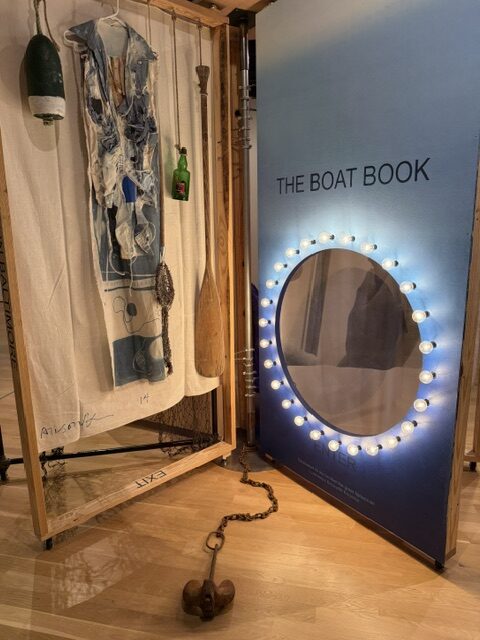
The Boat Book is a mixed media installation with eight pages in the round, each 96 x 48 x 4 inches. Blink is a bright yellow 1963 screen print and synthetic polymer paint on canvas by George Brecht, Alison Knowles, and Robert Watts divided into three parts: open and closed scissors at the bottom, the capital letters B L I N K in the center, and a wedding in Bali at the top. These juxtaposed images are compelling in part because they seem to have no connection to each other yet they connect anyway.
What makes this exhibition so unexpected and unexplainable is that it asks us to become art spies—to see art everywhere!
Following its opening at the Berkeley Art Museum and Pacific Film Archive in July, 2022, this exhibition has spent time at the Museum Wiesbaden in Germany; Saint-Etienne, France; and Nikolaj Kunstahal, Copenhagen. The Grey Art Museum is the last and only East Coast venue.
The 276-page accompanying book is beautifully produced. It features contributions by international Fluxus curators, historians and scholars, a conversation with poet George Quasha, and more images of Knowles’ Each Red Thing series. It has over 250 images, special colored papers for each section, die-cut section dividers and a chronology. Each book cover is unique. This was published by the University of California, Berkeley Art Museum and Pacific Film Archive.
Extra Scoops: On my way to the Grey, I discovered the Merchant’s House Museum at 29 East Fourth Street. The entrance is hidden inside a park that leads to an inner garden courtyard where I met a young couple enjoying a private moment. Inside the garden, a five-story 1832 house has period furnishings and a secret passageway that may have been part of the Underground Railroad. Holiday add-ons include a casket for Halloween and a Christmas Carol performance that runs November 24 – January 3, 2027.
Nearby on 57 Great Jones Street, Atelier Jolie, Jean Michel Basquiat’s former studio, was enjoying a quiet afternoon of art with coffees, teas, and exotic bites. Next door at 45 Great Jones, two bouncers were monitoring the 1 ½ block line for Ashley Longshore’s and Noz Nozawa’s pop up shop (through January 3) that day selling Harry Styles merch –hot pink shorts $80! Shorter hot red shorts with a respect your mother sidebar!
Jan Castro co-founded River Styx in St. Louis with New Yorker Michael Castro (1945-2018). Her books include the bestseller The Art & Life of Georgia O’Keeffe, the traveling exhibition Sonia Delaunay: La Moderne, and Margaret Atwood: Vision and Forms. She is Contributing Editor at Sculpture Magazine (20 cover stories, www.sculpturemagazine.art ) and has stories online at www.whitehotmagazine.com and www.Google,com.