
When I was a kid, I had a dream, a wonderful dream. I would dress up in my parents’ clothes or my toy-store tutu, bound into my parents’ bedroom, fling open my arms, yell ta-da and do a little song and dance.
Before long, shyness and trouble singing on key knocked the budding entertainer right out of me. Then about ten years ago I had a piece of prose accepted for a revue called “New York Ladies” at the Hudson Guild Theater, and I learned that this entitled me to be in the cast if I wanted.
Did I want? I sure did. Four more shows followed. I read my Uta Hagen. I learned the lingo (call the audience “the house,” the technical rehearsal “the tech,” side-stage curtains “legs”). I highlighted and learned my lines. I got measured and fitted, most proudly in a wig and a corset to play Pearl, one of the tarts in “The Iceman Cometh.” I grew queasy with stage fright. I bonded with the cast and crew. I didn’t quite fling open my arms and yell ta-da, but close enough. I loved it all.
And then I got unexpectedly busy with my main pursuits of writing, teaching and editing. The old dream receded again, I assumed for good. I was fine with this; I’d had my fling.
So I was taken aback to find myself returning to the boards, as they say, this time at the venerable downtown experimental theater Dixon Place. Once again, it was my writing that got me in the door. In February they put out a call for written pieces for a program of short dance and spoken word on the theme “Threat to Democracy.”
Ellie Covan’s living room
About Dixon Place: if you were in the city in the 80s, when the stage was founder Ellie Covan’s living room on 1st and 1st, you may get the same little thrill I do hearing the name, right up there with other renegades like La MaMa and Theater for the New City. I’d done a couple of literary events with Dixon Place, but had never set foot in the black-box theater, which I now know is reached by climbing down one staircase, down a hall and up half another one (if you’re hungry enough for an arts space, you can transform any old New York building into one).
I submitted an oddball piece of prose I did as a free-write one day, called “Toward a New Mythology.” It starts like this: “Darlene is our goddess of bullshit detection and Roy our god of line dancing.” Seemed like a longshot, but it was one of ten chosen pieces. Each of us was paired up with a professional choreographer. Mine was Billy Blanken, of Sheep Meadow Dance Theatre based in Queens. There would be two performances on June 1.
Billy and I met on Zoom and I knew I was in good hands right away. But I also wasn’t sure what my role, if any, might be. I wasn’t sure if I wanted a role: all that work and angst after all these years. We danced around a little. I told him I had some acting chops and offered to read my own piece. He accepted. Then I learned that he rehearses in Queens on Tuesdays, when I’m teaching in Manhattan. Gulp.
Billy told me I wouldn’t have to memorize my piece, and that he had other pressing projects to tend to first, so I tucked the whole pending thing into the background of my full life. And then one day in May he sent me a video of the first rehearsal.
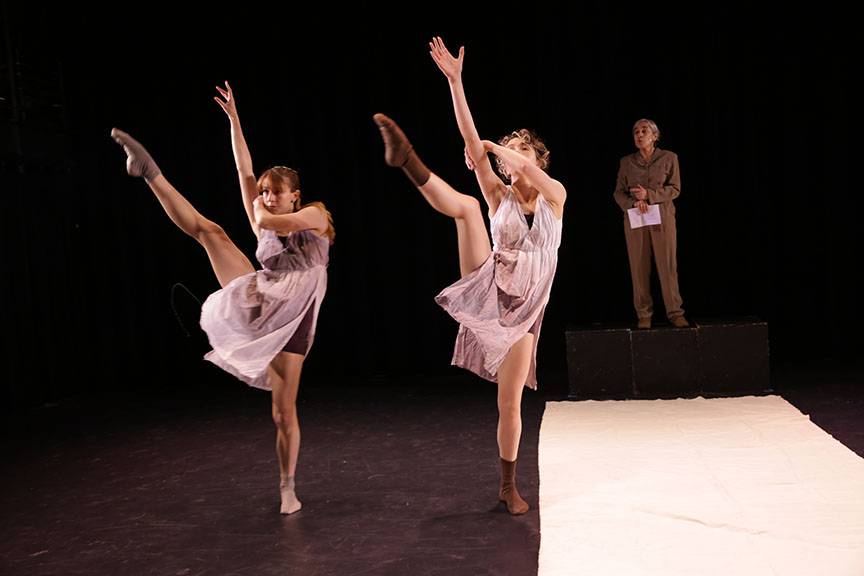
The piece was already fully formed, sprung to life via two lovely young dancers with impossibly long, slender bodies. My monologue about made-up gods and muses had legs! I thought: my squat little frame sure is going to look funny next to these beauties. Then I thought: I really have to do this thing and I’m terrified.
We finagled one hour to rehearse together, on a day when Billy had a studio reserved in Manhattan. I made a long paper scroll with my words, picturing myself unrolling it like a town crier. Only problem: the blocking required me to hold hands with the dancers at various spots, so I had to keep rolling the scroll back up and tucking it in my armpit.
I was going to have to memorize the darned thing (be “off book”) after all.
It was a landmine of multi-clause sentences, random names and titles, like “Brasilia, the goddess in training, assigned to Roy, of working the room to be sure no one got left out.” I would have to wrap my tongue around “peaceful governance and apolitical analysis.” One night I grew so frustrated while practicing in the living room that I said to my husband: who wrote this drivel?
No short cut
Memorizing is a process you can’t rush. Trying harder is like turning the hose on your plants until the pots overflow instead of giving them time to absorb the water. I’ve always come at it by getting one chunk under my belt and then moving on to the next, looking down my nose on the holistic types who learn the basic idea and fudge the rest. This is because I’m a perfectionist from way back, but also because acting is a give and take. Part of an actor’s job is to provide cues for others; our performance would have no music so the dancers were counting on me to provide the pacing and transitions.
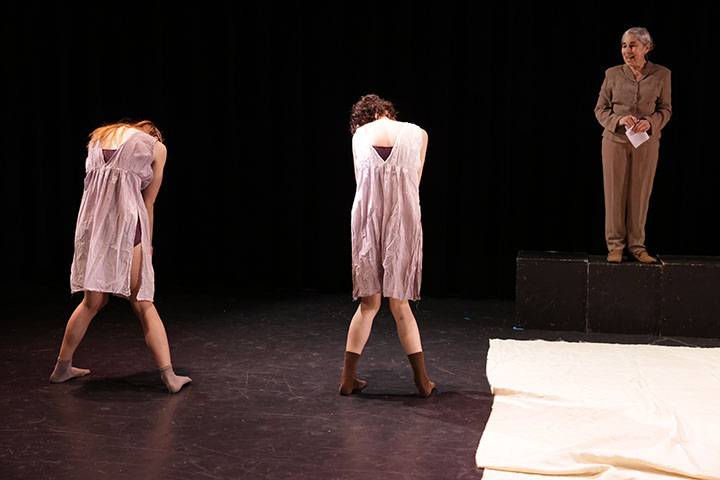
May rushed by. My brain slowly absorbed the words I had so blithely put on the page. It was costume time. It gradually became clear that I had to come up with my own to fit my non-dancer proportions and my non-dancing role. I pictured flowing robes, befitting a god of a made-up universe. But the more Billy got to know my piece, the more he saw my character as the twisted leader of a world not as peachy as it seems, and the more he pictured something a little more Star Trek or Hunger Games. I pulled things from my closet, including the one pantsuit I’ve ever owned. It has a 40s retro look: fitted jacket with shoulder pads, pleated trousers with a nice drape. Bingo. It read malevolent boss-god.
June 1: performance day. Two shows, 4 and 7 p.m. Run-through at 11; tech at 1:30. I was nearly sick with nerves. I recited the monologue in my head nonstop. I knew it’s par for the course for lines to go poof and disappear temporarily from the wonky storage facility known as a brain, but found no solace in this knowledge.
I had never spent a day in a dressing room with dancers before. My, how they talk about their ailments! We writers complain about writer’s block, but they have a whole body full of muscles and ligaments and joints that can fail at any time.
Our little troupe found an empty room to rehearse in (“run the piece”). The young dancers in their diaphanous shifts and headdresses were gracious as I flubbed lines and, worse, couldn’t stop apologizing. Billy, bless him, offered nothing but quiet encouragement, though I was having trouble embracing my inner autocrat.
Then I was fitted with a “lav,” short for lavalier, a little mic hooked around my ear with a power pack tucked into the back of my waistband. I’d heard actors talk about the one small thing—a hat, a deepening of the voice—that unlocks a character for them. Well, the minute they taped that mic to the side of my face, I felt like a TED talk author: important, maybe even self-important. Exactly what I needed.
After what felt like a month of waiting, the program began. We came on toward the end. More waiting and pacing. At one point the artistic director looked at me with great concern and asked if I was alright.
Our piece has pomp: the dancers come out and unfurl a vast length of fabric from upstage to downstage. Then they come to get me from the wings, hold my hands and usher me onto the stage. I step up onto a big black block.
I saw some friends in the audience and ignored them, as I’d learned to do back at Hudson Guild. I opened my mouth and talked about Darla, the goddess of bullshit detection, and Roy the god of line dancing. My monologue flowed. My gestures felt natural. Not a single flub. Nice crisp curtain call. Applause.
One down and one to go. I knew my family was coming to the 7 o’clock show. I was exhausted from pacing all day. All I wanted was for it all to be over. I told myself to stop saying yes to things (after a lifetime of learning to say yes to things).
I don’t remember much about this performance because I was too caught up in bossing my gods around. I know I made a couple of minor flubs but I covered and kept going, which I’ve always found very hard to do. I know that I ad libbed, with no conscious thought, a finger-twirling hurry-up gesture at the dancers. After that all I remember is sustained applause and the grin on Billy’s face. He wants us to do the piece again. Am I game? Yes!