

At the end of 1977I flew to London to join the Ramones for their New Year’s Eve Concert at the Rainbow Theatre. I had not been to London since 1974. When the Ramones and their manager, Danny Fields, invited me to join them at the Marble Arch Holiday Inn and review their New Year’s Eve concert at The Rainbow for High Times it seemed like an ideal opportunity to check out the London punk scene. The headlines of The Sun were devoted to the Sex Pistols. A series of gruesome stories continued inside the paper. “Rotten’s Brother May Lose an Eye,” read one headline.
“We’ve ‘ad enuf trouble already,” said Mrs. Rotten, “and now this!”
On New Year’s Eve I had lunch with several local rock critics brimming over with enthusiasm for punk rock in England and America, but they set me straight: “All the American groups – except the Ramones who sold out all their concerts – “have died here,” they assured me, adding “Americans don’t understand English punk at all. The English punk audience is younger (15-18). They are all truly frustrated, bitter kids who, partially because of British licensing laws, have to get drunk quickly. English punks are totally committed. Punk rock is not an entertainment it is a cause.” I was reminded of William Burroughs’ 1962 Edinburgh statement, “I am not an entertainer”.
A few hours before the concert I quizzed Tommy, Johnny and Dee Dee (Joey was destroying his room taking a shower) about British punk. They sat on a single touseled bed like kids watching T.V. Tommy had just told me how the previous night two of the most beautiful Scandinavian blondes he had ever seen in his life crept into the room he shared with Dee Dee and fulfilled every fantasy imaginable.
“The kids in England are more open to things and a little hipper in terms of picking up on something that’s different and good,” Johnny explained. “They’re looking for new groups. In the United States they’re not really looking: the groups have to be pushed on them. In reality the English punk scene and the American punk scene are almost the same thing. Because the kids who go places to see you are just regular kids. The actual punks are very few both in the United States and England.”
“A lot of English kids are bitter toward the United States,” Dee Dee added. “You see it all over. We feel it constantly. People write letters to the fanzines saying bitter things, groups write songs that are bitter about the United States. They think we can’t relate to their problems, we’re singing jolly songs while they’re singing about getting a job. Well, we didn’t have any jobs either when we started a group, but you can’t just sit around being depressed about it all the time. It’s the difference between the American and British mentality. We think it’s a joke already, they get completely negative about it.”
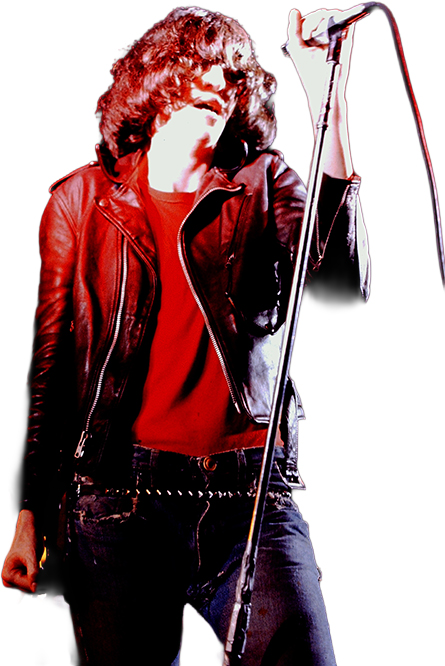
I asked the Ramones about the Sex Pistols:
“We saw the Sex Pistols,” said Johnny. “Their entire setup cost $1,000 and the show was boring. They didn’t relate to the audience, they were just withdrawing through the whole set and huddling closer to the drums. We like them, but we don’t like being around people who use drugs, it makes us nervous. And they’re misinformed by their manager.”
“We talked to Sid Vicious and said something about the States and he didn’t know anything about it,” Dee Dee continued. “We feel bad for them…That Johnny guy has got interesting phrasing, but he can’t carry a tune. Maybe he doesn’t want to – he’s a punk, right?”
Best I ever saw
I watched the show from backstage, going out into the audience a couple of times. People were hanging off the ceiling. The band were in top form and gave it their all, sounding remarkably similar to their records. This was the best Ramones concert I ever saw. The band was superb. But the audience was also great. As they careened off stage into the treacherous, dark backstage, Dee Dee burst out “That was fun!” Joey was winded, but there was a definite feeling of success; they all felt really good.
I didn’t wait for the encores, I wanted to be well positioned in the dressing room. I was rewarded by this remarkable sight: an almost magically attractive, slim lad wearing a red tee shirt and tight black jeans, that looked to be painted onto his long well proportioned legs, was hunched on a bar stool in the center of the almost empty room. A blonde punk kneeled before him, her face buried in him.
Sticking out a hand I asked, ”What’s your name?”
“Sid” he replied in a soft, friendly voice.
I was facing the notorious Sid Vicious, so called for his habit of cutting rock critics with bicycle chains. The tableau sent me reeling back to Muhammad Ali’s dressing room at Madison Square Garden in 1971 where and when immediately after he lost the first Frazier fight Diana Ross had her head buried in Muhammad Ali’s lap. But this was not a good comparison because Sid had not lost yet. In fact, he had never been more gloriously together. He glistened with the glow celebrities get from being turned on by their public.
At first I thought that Sid’s euphoria was a result of having recently joined the Sex Pistols, who were on the eve of 1978 the most famous rock band in the world. They were just about to embark on their American tour. However, when I assured him that everybody was looking forward to their U.S. visit then requested a shotgun interview with High Times, he replied that if I brought a ten quid wrap of heroin we could meet on the following afternoon. When I replied I had no money he stared now moodily into his beer then muttered, “Yes you ‘ave.”
Four encores
After being called back for an uncharacteristic four encores by their raving, capacity audience, the Ramones repaired to their dressing room. I went upstairs to the bar and became immediately aware of the scowling Johnny Rotten (who looks exactly like Johnny Rotten) ensconced at a table with his protective entourage, including a female dwarf. I had an impulse to march over and tell him just how greatly the Pistols arrival in the U.S. was being anticipated by growing legions of hardcore fans, but to no avail. The aura of protection around him was so steely and dismissive I would have been inviting an unwanted rejection. Why is Rottten the most popular singer in England? He projects the most intense hatred. As the Ramones pointed out, the English are seriously into their negativity. Twenty minutes and six drinks later, I went back down to the Ramones’ dressing room. It was now packed with Britain’s punk rock elite. All the Pistols were there.
Around midnight we left the dressing room and I followed the band into the enormous back of an Austin Princess limousine, which was driving us to Elton John’s restaurant, “Friends.” Sire Records owner Seymour Stein sat in the front seat.
When he asked if anybody had coke, for a second somebody thought I did. Seymour immediately started stroking my hand. When I remonstrated that I had nothing he instantly turned away. For the rest of the trip Johnny Ramone, the band’s business head, yelled at Stein: “No posters, no records in the stores, the same old shit!”
You could tell Seymour was used to this, it bounced off of him as he repeatedly apologized and said it would get better, encouraging them to believe they had a hit single in the offing. The Ramones were so much bigger in the U.K. than the U.S. then there was no comparison. In England they were big stars.
We were all amazed when we walked into Elton John’s restaurant because there was nobody there, except four fat guys playing Christmas songs and Elton’s manager in a Scottish kilt. We looked at each other and chorused, “Let’s get drunk!”
I sat next to Joey. We talked. It was fun but with the bagpipe music background and his incredible hair, which got into my face and food every time he leant down to hear what I was saying, it was not easy. Each time I shouted up into his ear he nodded and grinned. Joey is a very appealing, lovable guy. Plus he must have been feeling terrific because he had just delivered, the band had, not just a wonderful, but a powerful and complete show. Dee Dee had a morose, British bird with him. Johnny and Tommy looked pissed off, but they gobbled down the food that was better than what they got most nights on the road. The place was just moribund. There were – literally – no other customers.
By the time we returned to the hotel around 4 a.m. I was several sheets to the wind and apparently, getting into the elevator, I tried to pick up somebody’s girl friend. Everybody laughed. The Ramones and their manager, Danny Fields (“Danny Say) were very nice to me.